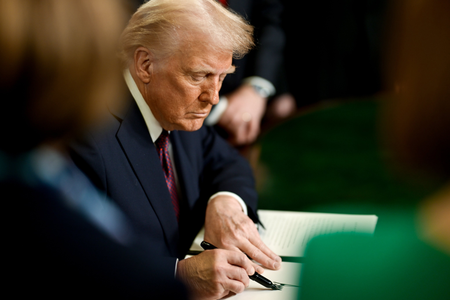
Washington, Dec 5 (IANS) India emerges as one of the central pillars of the United States’ Indo-Pacific strategy in President Donald Trump’s new National Security Strategy (NSS).
The document, released by the White House on Friday, lays out the administration’s strategic vision for global engagement and identifies India as a critical partner in securing a “free and open Indo-Pacific.”
The strategy notes that Washington “must continue to improve commercial (and other) relations with India to encourage New Delhi to contribute to Indo-Pacific security, including through continued quadrilateral cooperation with Australia, Japan, and the United States (‘the Quad’).”
It links India’s growing economic and military heft to the broader U.S. goal of ensuring that the region remains free of domination by any single power.
Reiterating its view of the Indo-Pacific as the defining battleground of the 21st century, the NSS states that the region already accounts for nearly half of global GDP and will drive future global growth.
A central U.S. objective, it says, is to “prevent domination by any competing power” and to preserve freedom of navigation across the South China Sea — an area through which one-third of global shipping passes annually.
“Strong measures must be developed along with the deterrence necessary to keep those lanes open,” the document warns, adding that countries “from India to Japan and beyond” stand to suffer if maritime choke points become subject to control or coercion.
It highlights President Trump’s recent regional diplomacy, saying that agreements signed during his October 2025 Indo-Pacific travels “further deepen our powerful ties of commerce, culture, technology, and defence.”
Technology cooperation is another area where India features prominently. The NSS says the U.S. must “enlist our European and Asian allies and partners, including India, to cement and improve our joint positions” in emerging industries, supply-chain development, and the global competition for critical minerals.
The document frames India as part of a coalition that can help advance U.S. leadership in AI, energy technologies, quantum computing, and autonomous systems.
Beyond economics and technology, the strategy repeatedly emphasises deterrence and burden-sharing. It calls on partners across the First Island Chain to invest more in their defence and urges deeper military cooperation to “deny aggression anywhere in the First Island Chain.”
India is cast as a consequential regional actor whose choices will influence the broader balance of power.
In its framing of global competition, the document refers to President Trump’s approach as “America First diplomacy” — one that seeks fair, reciprocal trade, strong national borders, and protection of American workers. While sharply critical of “predatory, state-directed subsidies,” intellectual property theft, and coercive economic behaviour, it presents.
–IANS
lalit/dan