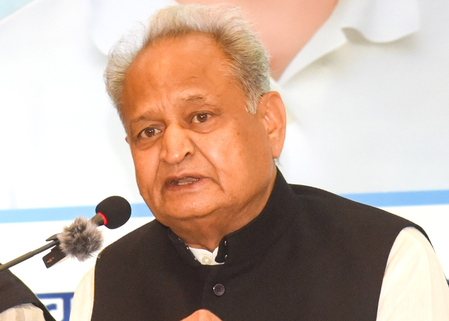
Jaipur, Dec 23 (IANS) Former Rajasthan Chief Minister Ashok Gehlot on Tuesday expressed concern over Union Minister Bhupender Yadav’s statement that only 0.19 per cent of new mining would be permitted in the Aravalli region. Gehlot suggested that the figures presented may not fully reflect the ground realities and called for greater transparency in the matter.
He said the Union government’s claim that mining will be limited to 0.19 per cent of the total 1.44 lakh sq km area could be misleading, as this area includes 34 districts comprising cities, villages, farms and plains, in addition to the hills. “The actual Aravalli hill range is not so vast. Mining will take place only on hills,” Gehlot noted.
While 0.19 per cent may appear small in comparison to the overall area, Gehlot said it translates to 273.6 sq km, or around 68,000 acres. He explained that if small mining leases of one hectare (2.5 acres) each are allotted, as many as 27,200 mines could be legally sanctioned. He cautioned that the impact of mining extends beyond the mines themselves, with roads, dumping yards, crushers and dust potentially affecting fertile land, agriculture and the surrounding environment.
Gehlot also referred to two amendments to the Mines and Minerals (Development and Regulation) Act (MMDR), saying they raise questions about state autonomy. He pointed out that the MMDR Amendment 2021 allows the Centre to auction mineral blocks if a state fails to do so within a stipulated time, while the MMDR Amendment 2023 gives the Centre control over minerals classified as “critical,” such as lithium, copper and zinc. “In the Aravallis, copper and zinc are found deep underground,” he said, adding that private companies may now be given exploration licences for large-scale digging.
He further mentioned concerns about changes in definitions of minor and major minerals, alterations to protected area boundaries, and the weakening of the Central Empowered Committee (CEC). Gehlot cited the example of the Sariska Protected Area, where he said changes were attempted within three days.
“Our point remains that this is not just about 0.19 per cent. The larger issue is the future of the Aravallis, Rajasthan’s environment, agriculture and coming generations. The government must clearly state whether it intends to protect the Aravallis or expand mining there,” Gehlot said.
–IANS
arc/dan