New Delhi, Dec 26 (IANS) The country’s CSIR labs are driving Atmanirbhar Bharat through innovation, indigenous technologies, said Dr. Jitendra Singh, Union Minister of State (Independent Charge) for Science and Technology, on Friday.
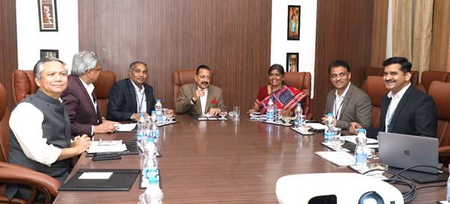
Reviewing the scientific achievements and technological contributions of Chennai- and Hyderabad-based CSIR laboratories at a meeting held in Tirupati, the Minister underscored acceleration of technology transfer to upscale India’s industrial engagement.
“Stronger industry partnerships and faster translation of laboratory research into societal and commercial applications are critical to building an Atmanirbhar Bharat,” Singh said.
“CSIR continues to play a pivotal role in strengthening India’s scientific capabilities and supporting the vision of Atmanirbhar Bharat,” he added.
The review meeting focused on assessing recent accomplishments of the laboratories and their alignment with national priorities, against the backdrop of the sustained impetus provided by the Government of India to strengthen the country’s scientific and innovation ecosystem.
Directors of CSIR laboratories from Karaikudi, Hyderabad, and Chennai presented their key achievements and outlined future pathways for impactful research, innovation, and industry collaboration.
Dr. K. Ramesha, Director, CSIR-CECRI, highlighted CSIR-CECRI’s work in electrochemical technologies, energy storage, and clean energy, with indigenous efforts in sodium-ion batteries, metal recovery from spent batteries, green hydrogen production, and CO₂ capture.
Dr. Prakash, Director, CSIR-NGRI, outlined CSIR-NGRI’s initiatives providing geophysical insights into Ladakh, geothermal energy exploration, mapping of critical minerals, and development of a strain map of the Indian Plate, along with mission-mode programmes on Himalayan geo-hazards and heliborne surveys for the SLBC Tunnel project.
Dr. P. Thanikaivelan, Director of CSIR-CLRI, presented CSIR-CLRI’s development of the indigenous ‘Bha’ footwear sizing system, advanced defence gloves transferred to industry, touch-sensitive gloves for the Indian Air Force, pan-India gait studies, and leather waste conversion into value-added products.
Dr. N. Anandavalli, Director, CSIR-SERC, detailed CSIR-SERC’s focus on offshore renewable energy infrastructure, structural health monitoring, sustainable materials, and disaster-resilient construction technologies, including ERS, blast-resistant LSCC, and bullet-proof security booths.
Dr. Vinay Nandicoori, Director, CSIR-CCMB, highlighted CSIR-CCMB’s achievements in genomics, diagnostics, and biotechnology spanning human health, animal welfare, and plant health; while Dr. D. Srinivasa Reddy, Director, CSIR-IICT, briefed on CSIR-IICT’s advances in pharmaceuticals, vaccine adjuvants, new-generation refrigerants such as HFOs, and its strong emphasis on translational research and industry collaboration.
–IANS
rvt/