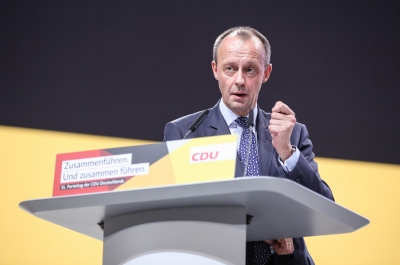
Berlin, Dec 31 (IANS) Delivering his New Year’s address on Wednesday, German Chancellor Friedrich Merz said that Europe must strongly assert its own interests in an increasingly volatile world.
In the address, Merz characterised the current global situation as an “epochal shift,” marked by geopolitical upheavals, a return to protectionism, and changing transatlantic dynamics, Xinhua News Agency reported.
“Our partnership with the United States of America, which has long been the reliable guarantor of our security, is changing,” he said. “For us Europeans, this means that we must defend and assert our interests much more strongly by ourselves.”
Addressing the security situation, Merz said that Germany must improve its deterrence and defence capability to ensure long-term peace.
In terms of economy, he pledged that his government, formed after the federal elections in February 2025, would focus on restoring Germany’s competitiveness by cutting red tape and fostering technological innovation.
“We are not the victims of extraneous circumstances. We are not at the mercy of great powers,” Merz said, stressing that 2026 can be a decisive year for Germany and Europe.
“It can be a year in which Germany and Europe, with new strength, reconnect with decades of peace, freedom and prosperity,” he said.
Earlier this month, Friedrich Merz said that parts of the newly published US national security strategy are “unacceptable” from a European perspective, stressing that Germany and Europe must be more independent from the United States in terms of security policy.
Merz made the remarks during a press conference in the state of Rhineland-Palatinate, Germany.
He said he was “not surprised” by the document and acknowledged some aspects as comprehensible, given that U.S. Vice President JD Vance has accused Europe of straying from “fundamental values” shared with the United States at the Munich Security Conference in February.
However, Merz also voiced his disagreement with part of the US strategy. “I see no necessity for the Americans now wanting to save democracy in Europe,” Merz said. “If it were to be saved, we would manage that on our own.”
He noted that the “America First” principle is particularly evident in the strategy. While expressing acceptance of “America first,” Merz stressed that “‘America alone’ cannot be in your (the US) interest. You need partners in the world.”
Several US and European news outlets have pointed out that in the 30-page US National Security Strategy, barely two and a half pages are devoted to Europe. The Financial Times reported that the document “highlights the ideological gulf that has opened up between Washington and its traditional allies.”
–IANS
akl/as