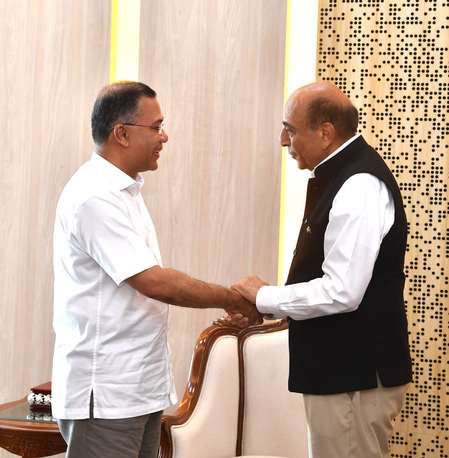
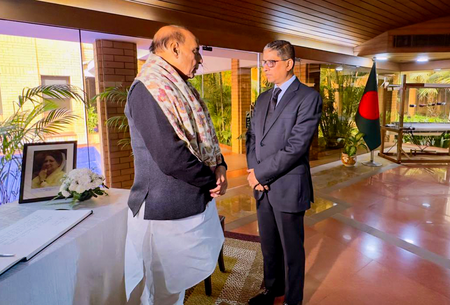
New Delhi, Jan 2 (IANS) India’s External Affairs Minister S. Jaishankar’s Dhaka visit to attend former Prime Minister Khaleda Zia’s funeral on Wednesday and Defence Minister Rajnath Singh visiting the High Commission in New Delhi to pay respects to the departed leader is significant, given the current situation, observed a leading Bangladesh daily.
“The brief visit of India’s foreign minister S Jaishankar to Dhaka over the past two days, along with Defence Minister Rajnath Singh’s visit to the Bangladesh mission, is significant,” said a Prothom Alo analysis.
“Since the popular uprising of 5 August 2024, which led to the fall of the Awami League government and Sheikh Hasina’s flight to India, relations between the two countries have deteriorated,” it added.
Earlier, Bangladesh High Commissioner to India Riaz Hamidullah had posted on social media ‘X’ that following Jaishankar’s Dhaka visit, India and Bangladesh can look forward to scripting a new chapter in bilateral ties.
Incidentally, Hamidullah was summoned back to Dhaka on Monday amid rising bilateral tensions between the two neighbours.
“As (India) Hon External Affairs Minister HE Dr @DrSJaishankar left Dhaka following a whirlwind 4-hr visit, #Bangladesh & #India would look forward to script a new chapter in (Bangladesh-India) ties, in shared interests driven by pragmatism and mutual interdependence, as indeed briefly discussed with @bdbnp78 Acting Chair, @trahmanbnp this afternoon,” he wrote on Wednesday.
The last part was in reference to the External Affairs Minister meeting the deceased former Prime Minister’s son Tarique Rahman, who is Bangladesh Nationalist Party (BNP) Acting Chairman, and handing him Prime Minister Narendra Modi’s condolence letter.
Also acknowledging the Defence Minister’s visit, Hamidullah wrote the next day, “Honoured to welcome HE @rajnathsingh, Hon (India) Defense Minister at @bdhc_delhi as he conveyed condolences of #India and paid homage to former (Bangladesh) Prime Minister | @bdbnp78 Chairperson (late) #BegumKhaledaZia, in Delhi.”
Friday’s analysis in Prothom Alo appears to echo the High Commissioner’s observations on the development, referring to his social media posts.
“Yet, barely a week later, Rajnath Singh’s visit to the Bangladesh High Commission to pay respects to Khaleda Zia, is significant. In addition to honouring the former Prime Minister of Bangladesh, his presence at the High Commission signals that Delhi is taking responsibility for ensuring the highest level of security at the mission,” wrote the newspaper’s Diplomatic Editor Raheed Ejaz on Friday.
The piece, however, failed to mention the violence in Bangladesh and the killings of Hindu and other minority citizens. It rather highlighted demonstrations and protests in India voicing the ongoing atrocities.
Violence in Bangladesh has sharply escalated, with Hindu minority citizens facing targeted killings. At least 12 Hindus were murdered in mob lynchings and extrajudicial attacks last month. These incidents have heightened anxiety among minority communities and raised questions about Bangladesh’s ability to protect vulnerable groups.
The violence undermines social cohesion and democratic transition, especially ahead of the February 12 elections.
Authorities often present each killing as an isolated crime, but it reveals how political instability, religious radicalism, and weak institutions converge to leave minorities vulnerable. The Prothom Alo piece, headlined ‘Delhi eager to take bilateral relations forward’, ended portraying Bangladesh authorities’ uncertainty.
It recounted that when Touhid Hossain, Adviser for Foreign Affairs of the Interim Government, was asked whether Jaishankar’s visit would ease tensions between the two countries, he replied, “You will have to look for the answer in the days ahead. In the coming days, you will see what happens.”
Dhaka needs to reciprocate, not appear uncertain, passing on the responsibility and response to future.
–IANS
jb/rad