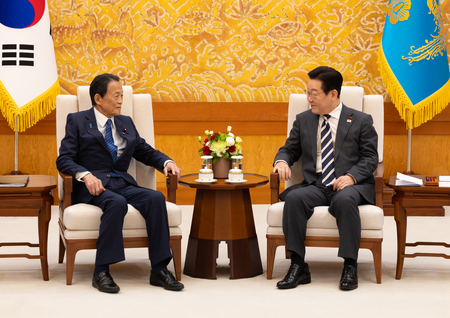
Seoul, Jan 16 (IANS) South Korean President Lee Jae Myung said Friday that Seoul and Tokyo have to seek mutually beneficial relations by improving bilateral ties.
In a meeting with former Japanese Prime Minister Taro Aso, Lee said South Korea and Japan are neighbours using a front yard together.
“It is desirable to find out as many areas as possible where the two countries cooperate, so as to create a mutually beneficial relationship” Lee said, Yonhap News Agency reported.
Lee’s meeting with the former Japanese prime minister came as he took a trip to Japan earlier this week for talks with Japanese Prime Minister Sanae Takaichi on ways to broaden and deepen bilateral cooperation amid tensions between Beijing and Tokyo.
The president met Takaichi in her hometown of Nara, marking his second visit to Japan and his fifth summit with a Japanese prime minister since taking office in June last year.
It was their second summit following their first meeting in South Korea’s Gyeongju in late October.
During Tuesday’s talks, the two leaders agreed to advance “future-oriented cooperation” through reciprocal leader-level visits, dubbed “shuttle diplomacy.”
Lee said his meeting with Aso right after the summit talks is making Korean people think that Seoul-Tokyo relations may be abruptly leveled up.
Aso said the second summit between the leaders of Japan and South Korea in less than three months is very meaningful.
“The international situation surrounding Japan and South Korea is changing, and close cooperation is mutually beneficial to both Japan and South Korea,” Aso said.
On January 14, South Korean President Lee Jae Myung returned home after a two-day trip to Japan, during which he held talks with Japanese Prime Minister Sanae Takaichi on ways to broaden and deepen bilateral cooperation amid tensions between Beijing and Tokyo.
Lee met Takaichi in her hometown of Nara, marking his second visit to Japan and his fifth summit with a Japanese prime minister since taking office in June last year. It was their second summit following their first meeting in South Korea’s Gyeongju in late October.
During Tuesday’s talks, the two leaders agreed to advance “future-oriented cooperation” through reciprocal leader-level visits, dubbed “shuttle diplomacy.”
They reaffirmed their commitment to the complete denuclearization of the Korean Peninsula, while Lee also emphasized the need for Seoul, Tokyo and Beijing to find common ground for cooperation in Northeast Asia.
Sensitive issues, including South Korea’s ban on Japanese seafood imports, were raised as Seoul seeks to join the 12-member Comprehensive and Progressive Agreement for Trans-Pacific Partnership, which is led by Japan.
While South Korea reiterated its bid to join the pact, Japan explained its position on food safety, National Security Adviser Wi Sung-lac said, adding that further working-level consultations are needed.
The summit also addressed historical issues that have long weighed on bilateral ties. Seoul and Tokyo agreed to conduct DNA analysis to identify remains discovered last August at the Chosei undersea coal mine in Japan’s Yamaguchi Prefecture, where a flood in 1942 killed 183 people, including 136 Korean forced laborers.
Lee’s visit also provided opportunities for the two leaders to build personal rapport through lighthearted moments, including an impromptu drum session, exchanging gifts and touring Horyu-ji Temple, a UNESCO World Heritage site known to have been influenced by the ancient Korean kingdom of Baekje.
–IANS
akl/as