Dhaka, Jan 17 (IANS) As Bangladesh gets ready to hold General Elections next month, attacks on women, girls, and religious minorities continue to rise, exposing the failure of the interim government headed by Chief Advisor Muhammad Yunus to protect basic fundamental human rights of the country’s citizens.
Citing police data, New York-based Human Rights Watch (HRW) highlighted that gender-based violence has increased between January and June 2025, in comparison to the same timeframe in 2024.
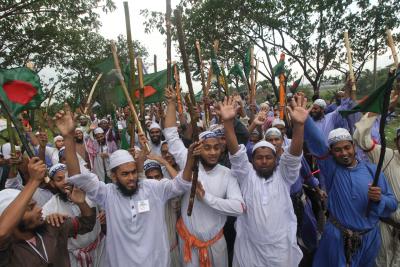
“Dr. Fauzia Moslem, President of the Bangladesh Mahila Parishad (Women’s Council of Bangladesh or BMP), attributes this increase to a rise in activity and rhetoric by religious groups seeking to restrict women’s free movement and participation in society. In May 2025, hardline religious groups protested the interim government’s efforts to improve gender equality and women’s rights and demanded an end to activities they deemed ‘anti-Islamic’. Since then, women and girls have experienced verbal, physical, and digital abuse that further silence their ability to speak out for fear of violence,” wrote Subhajit Saha, a Senior Coordinator in HRW’s Women’s Rights Division.
The General Election on February 12 will be the first that country would witness since the exit of democratically-elected government led by former Prime Minister Sheikh Hasina in August 2024.
The HRW report also detailed how attacks on Hindu and ethnic minorities have increased in the recent months.
“In December, Dipu Chandra Das, a 27-year-old garment worker, was beaten to death by a mob over alleged blasphemy. Rights groups have reported at least 51 incidents of violence against Hindus, including 10 killings. Ethnic minorities in the Chittagong Hill Tracts continued to face abuse from security forces after the revolution,” wrote Saha.
“Despite Bangladesh previously having two women Prime Ministers and many women participating in the 2024 student-led protests, women are still largely denied political participation. In the upcoming general elections, 30 out of the 51 political parties do not have any women candidates. Jamaat-e-Islami, an Islamist political group and one of Bangladesh’s two leading political parties, does not have a single woman candidate among its 276 nominations,” he added.
Terming it as a “matter of shame”, several reports have stated that the February election will see the lowest-ever participation of women candidates in Bangladesh elections.
Earlier this week, the local media in Dhaka reported that at an event titled ‘Nomination Crisis of Women Candidates: Gap between Parties’ Commitments and Implementation and the Accountability of the Election Commission’ held at the Dhaka Reporters’ Unity, many speakers stated that although the election commission of the country frequently talks about a “gender-inclusive election”, there is little reflection of that commitment in reality.
According to United News Bangladesh (UNB), representatives from Gonoshasthaya Abhijan, Durbaar Network Foundation, Nagorik Coalition, Nari Udyog Kendra (NUK), Narigrantha Probortona, Nari Sanghati, Nari Pokkho, Narir Dake Rajniti, Feminist Alliance of Bangladesh (FAB), Bangladesh Nari Mukti Kendra, and Voice for Reform participated in the event.
During the event, the forum leaders reiterated their opposition to reserved seats for women, saying they do not want women to enter parliament through special quotas. Instead, they want women to contest elections directly and secure representation based on merit.
“If the political parties fail to uphold their own manifestos and commitments, why should women trust them in the future, the speakers questioned,” UNB quoted one of speakers as saying.
Forum leader Samina Yasmin highlighted that women voters make up nearly 50 per cent, or possibly more, of the electorate in the country.
“Is it really possible to come to power by excluding 51 per cent of the population and relying on the remaining 49 percent? This is a fundamental question,” she mentioned.
Bangladesh’s Election Commission had earlier revealed figures highlighting the glaring disparity — despite women comprising half the population, they remain vastly underrepresented among candidates.
Among the 2,568 aspirants for the February 12 polls, only 109 — 4.24 per cent — are women, with 72 nominated by political parties, while the rest are independents, Bangladeshi leading newspaper The Daily Star reported.
Reports suggest that the exclusion is stark among the radical Islamist party Jamaat-e-Islami, which fielded 276 candidates without a single woman, followed by Islami Andolan Bangladesh with 268.
The Bangladesh Nationalist Party (BNP), which was led by a woman for more than four decades, allocated tickets to only 10 women out of 328 aspirants for the 300 seats.
Several parties, including Bangladesh Khilafat Majlis with 94 candidates, Khilafat Majlis with 68, and the Bangladesh Islami Front (BIF) with 27, have entirely shut out women, fielding only male candidates.
–IANS
/as