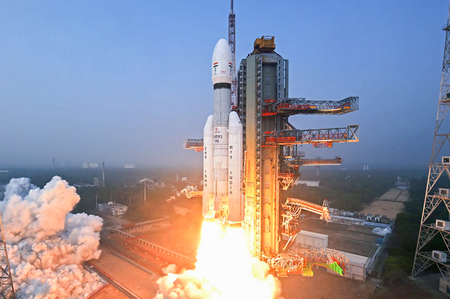
New Delhi, Jan 29 (IANS) Space services are poised for rapid expansion through commercialisation and public-private partnerships, said the Economic Survey 2025-26 tabled in Parliament on Thursday by the Union Minister for Finance and Corporate Affairs, Nirmala Sitharaman.
The Survey stated that the Indian space sector, valued at about $8.4 billion (around 2 per cent of the global space market), is projected to expand to $44 billion over the next decade. The growth is expected to be driven by launch services, satellite communications, earth observation, navigation, and a rapidly growing private ecosystem.
“India’s space sector has emerged as a fast-growing, technology-intensive and increasingly commercial segment of the services economy,” the Survey said.
Commercial launches have been a key export source, with India launching 393 foreign satellites for 34 countries between 2015 and 2024. This effort has earned nearly $143 million and 272 million euros, reflecting its cost-effective and reliable capabilities amid rising global demand for small satellites.
The Survey noted that the commercialisation has been strengthened through NewSpace India Limited (NSIL), whose revenues rose from Rs 322 crore in FY20 to Rs 2,940 crore in FY23, with further expansion projected in FY25 to Rs 3246.1 crore.
Demand-driven missions, satellite capacity leasing, and end-to-end commercial project execution, including dedicated launch services and the deployment of communication satellites, have also steadily improved profitability.
Satellite-enabled services are expanding rapidly, with India’s satellite data services market valued at $495 million in 2024, driven by applications in defence, climate services, logistics, and urban planning.
The Survey also mentioned the scaling up of India’s private “NewSpace” ecosystem across manufacturing, launch vehicles, data analytics, and downstream services. It has attracted over Rs 1,000 crore in private funding in FY23.
Further, policy initiatives such as the Indian Space Policy (2023), the operationalisation of IN-SPACe, and liberalised FDI norms have lowered entry barriers and enabled a transition towards a mixed public-private services model. This has enabled the space sector to evolve into a high-value, export-oriented, and innovation-driven services segment, the Survey said.
Meanwhile, the government informed the Parliament that about 1,050 private companies have, to date, provided their capabilities on the IN-SPACe Digital Platform (IDP) for various space activities.
“Till now, a total of Rs 2.36 Cr fund has been dispersed under IN-SPACe Seed fund and Preincubation Entrepreneurship Programme,” it said.
IN‑SPACe’s Decadal Vision Report provides a 10‑year roadmap to grow India’s Space Economy from $8.4 billion in 2022 to $44 billion by 2033, including $11 billion in exports.
The space economy is being catalysed through targeted efforts on demand generation, international collaboration, and promotion of space culture to expand markets, promote customer adoption, enabling industry to scale services and exports, the government said
–IANS
rvt/