Ahmedabad, Feb 2 (IANS) Ahmedabad has recorded steady gains in air quality management as the city advances a comprehensive clean air and green infrastructure programme ahead of the Commonwealth Games scheduled for 2030, with civic authorities reporting measurable progress across monitoring, transport, waste management and urban greening initiatives.
According to the Ahmedabad Municipal Corporation (AMC), a structured and data-driven approach has been adopted to address pollution at its source while supporting sustainable urban growth.
“Our focus has been on identifying local pollution sources and acting decisively through monitoring, enforcement and mitigation,” an AMC official said, adding that preparations for the international sporting event have accelerated environmental planning in line with global standards.
Nine pollution hotspot areas, including Pirana, Rakhiyal, Raikhad, Bopal, Vatva, Sardar Patel Stadium, Chandkheda, Maninagar and 16 construction and demolition (C&D) waste collection centres, have been scientifically identified.
Targeted action plans with special monitoring are being implemented in these locations to strengthen pollution control and improve ambient air quality.
Under the National Clean Air Programme and grants received through the 15th Finance Commission, 16 truck-mounted mist machines are operational in the city.
Six of these are deployed continuously at the Pirana dumpsite and adjoining areas, while 10 are assigned to identified high-pollution road corridors.
In addition, 62 mechanical road sweepers are in use for particulate matter mitigation. “These measures have helped reduce road dust and improve conditions along major traffic routes,” the official said.
The construction sector has also come under stricter regulation through the implementation of the Good Construction Practices Policy.
Construction sites with built-up areas exceeding 20,000 square metres are required to install dust sensors, air quality display boards and CCTV systems.
The policy also mandates misting, full covering of excavated material, green netting, paved internal roads and tyre-washing systems at entry and exit points.
Around 140 construction sites have installed dust sensors so far, with regular monitoring in place. Penalties of Rs 1.71 crore were imposed for violations in 2024–25, while Rs 1.16 crore has been collected so far in 2025–26.
In C&D waste management, 25 collection centres have been developed, and a 1,000-tonne-per-day processing plant is operational at Gyaspur.
A second plant of equal capacity is scheduled to become operational by December 2026, further reducing dust emissions from unmanaged construction waste.
Ahmedabad’s public transport system has shifted towards cleaner energy, with all 1,250 AMTS and BRTS buses operating on clean fuel, including 1,052 CNG and 207 electric buses. The city also has 128 electric vehicle charging stations, supported by solar-powered facilities.
“Cleaner mobility is a key pillar of our emission reduction strategy,” the official said.
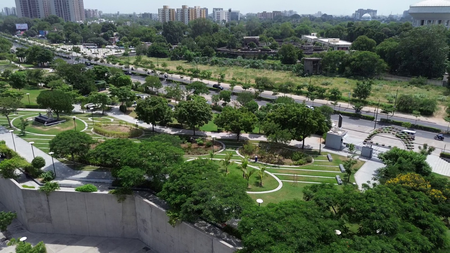
Urban greening has expanded with the development of 303 gardens and 118 urban forests, taking the city’s green cover to about 12.5 per cent.
More than four million saplings were planted in 2024–25 under a city-wide plantation drive.
AMC officials said that 95.69 per cent of the Rs 652.22 crore received under the National Clean Air Programme has already been utilised, reflecting close coordination between planning and execution as Ahmedabad works towards cleaner air and sustainable urban development.
–IANS
mys/uk