New Delhi, Feb 3 (IANS) Adaptive and more country-specific, India’s neighbourhood policy is no longer limited to historical goodwill as it responds to diverse political realities while safeguarding the regional stability, opined top policymakers, industry leaders, and domain experts at an insightful discussion.
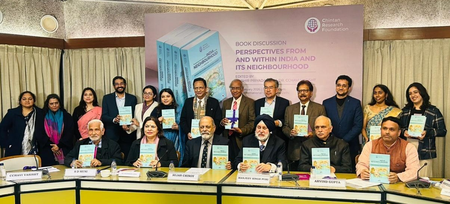
At the high-level dialogue organised by the Chintan Research Foundation (CRF) and titled ‘Perspectives From and Within India and Its Neighbourhood’, analysts deliberated on the evolution of India’s neighbourhood policy, conducting alongside thematic analysis on the economic, political, and security challenges confronting the region.
As nations grapple with the evolving regional and global geopolitics, the experts reckoned that India has increasingly sought to balance its security concerns, development partnerships, and economic diplomacy to foster stability and cooperation across South Asia and its extended neighbourhood.
They mentioned that India’s approach to its neighbourhood has long been shaped by geography and history, captured succinctly in former Prime Minister Atal Bihari Vajpayee’s observation that “You can change your friends but not neighbours”. This reality, the experts highlighted, continues to frame India’s neighbourhood policy, where enduring cultural ties intersect with hard strategic choices.
CRF President Shishir Priyadarshi, who has co-edited a book with Cchavi Vasisht on the same theme, emphasised that the neighbourhood constitutes India’s most challenging strategic theatre.
In his opening remarks at the event, Priyadarshi noted that India’s neighbourhood policy had become increasingly complex amid geopolitical competition, political transitions in South Asia, climate pressures, and rising expectations from a growing Indian economy. Stressing the vast diversity, ever-evolving nature and “non-linear” attributes of the region, he stated that a one-size-fits-all approach can’t be adopted by India while engaging with its neighbourhood.
The experts highlighted that shifting regional dynamics have added new layers of complexity to India’s neighbourhood engagement.
Recent years have witnessed political transitions and internal upheavals across South Asia, including developments in Nepal, Bangladesh, and Sri Lanka, requiring India to adapt its diplomatic and strategic approaches. Political unrest in Bangladesh in 2024, the situation in the Maldives and continuing internal conflict in Myanmar have underscored the need for a more calibrated, responsive neighbourhood strategy. These challenges have been further compounded by China’s expanding footprint in the region, particularly through the Belt and Road Initiative (BRI).
Vasisht, an Associate Fellow at the CRF, added that the region functions in a state of constant flux rather than fixed agency. She stated that ‘Neighbourhood First’ is not just a slogan in New Delhi and the allocations made to immediate neighbours in the Union Budget underlines that development assistance, connectivity projects, and capacity-building and security are today central to India’s regional diplomacy.
Further discussions highlighted India’s efforts to balance national interests with regional growth and security, including diplomatic initiatives such as engaging neighbouring leaders at the 2014 swearing-in ceremony and aiding during the Covid-19 crisis.
The experts concluded that while the principles of India’s ‘Neighbourhood First’ policy remain relevant, their execution must be recalibrated to account for changing domestic politics within neighbouring states, shifting public perceptions of India, and new forms of strategic vulnerability. Engagement must therefore be differentiated, recognising that Pakistan, Bangladesh, Nepal, Myanmar, Sri Lanka, the Maldives, Bhutan, and Afghanistan each demand distinct policy instruments rather than uniform diplomatic responses.
–IANS
/as