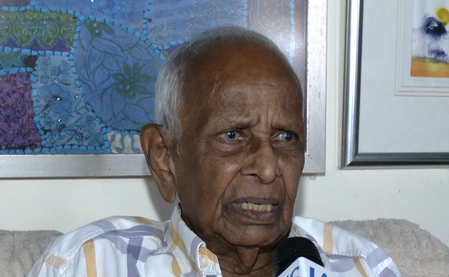
Kuala Lumpur, Feb 9 (IANS) Jeyaraj Raja Rao, a veteran of the Azad Hind Fauj, also known as the Indian National Army (INA), on Monday recounted his meeting with Prime Minister Narendra Modi in Kuala Lumpur and praised him for elevating India’s standing across multiple sectors.
Prime Minister Modi on Sunday interacted with veterans of the Azad Hind Fauj during his two-day official visit to Malaysia, underscoring the force’s historical significance and enduring legacy among the Indian diaspora in Southeast Asia.
During the visit, the Prime Minister met INA veteran Jeyaraj Raja Rao and described the interaction as deeply inspiring.
Responding to the meeting, Jeyaraj Raja Rao, in an exclusive interaction with IANS, said, “I, being a sentimental person, feel very blessed that I have had the privilege of meeting yet another great Prime Minister of India. PM Modi, in my mind, is a very vigorous and caring personality. He has done so much for the villages in India, building toilets, water systems, and then ensuring their continued maintenance, while also strengthening the economy.”
“He has also maintained equality by not giving any particular privileges to a specific community and treating all — Muslims, Hindus, Christians — equally, while also being very strong against the occasional belligerency of Pakistan,” he said.
“At the same time, India is growing economically, maintaining neutrality, and wisely staying aloof from exploiting countries, particularly the United States of America, which I see as belligerent, imperialistic, and extremely bullying. So I would like to congratulate him, and while doing so quietly, I am also thanking him. I feel blessed to have met a great man,” he added.
Speaking about the interaction, the INA veteran described the meeting as emotionally overwhelming, noting that it was significant for him that the Prime Minister took time to meet an “ordinary individual”.
“I think the common thread was Netaji Subhash Chandra Bose. I was garlanded by Netaji when I was hardly 12 or 13 years old, and the Prime Minister is very fond of Netaji. Netaji was indeed a great man,” he said.
“Basically, he was very happy to have met somebody who had met Netaji at a very young age. I told him very clearly that I am an Indian Malaysian, not a Malaysian Indian. I unashamedly confess that I am Indian first. I also congratulated him on how he has been able to keep so many ethnic Indians together in a democratic country, and that is a marvellous achievement,” Jeyaraj Raja Rao told IANS.
Reflecting on his memories of Netaji Subhas Chandra Bose, the INA veteran said three aspects of the freedom fighter’s personality and leadership left a lasting impression on him.
“First, through his eloquence, charm, and cosmic energy, he was able to unite all Indians. Before that, during both the Japanese and British periods, people identified themselves as Tamilians, Malayali, Telugus, Jaffnas, and so on. Netaji introduced the idea that we should first consider ourselves Indians to unite to liberate India from colonialism. That was the first strong impression I had,” he said.
“Second, he emphasised the need to liberate India from the British through militancy, the army, and revolutionary action. This was very different from Gandhiji’s concept of non-violence, and even Nehruji had reservations at that time. Netaji led this movement with great conviction,” he further stated.
“Third, he believed strongly in equality between men and women. He encouraged women to participate actively and even started a Rani of Jhansi force in Malaysia. I look up to him in many ways,” Jeyaraj Raja Rao added.
The INA veteran also expressed concern that the contributions of the Indian National Army are not widely understood or acknowledged, either in India or among the diaspora.
“Very sadly, I think not many people, whether in India or in our country (Malaysia), fully understand the immense contribution made by the Indian National Army to India’s Independence. They not only helped organise resistance but also went to Burma and intended to march towards Jammu to liberate India. Very few people know about their sacrifices. I may not recollect all the details now, but I know they were great soldiers,” he said.
Earlier on Sunday, sharing photographs of the interaction on X, Prime Minister Modi wrote, “It was very special to meet INA veteran Shri Jeyaraj Raja Rao. His life is marked by immense courage and sacrifice. Listening to his experiences was very inspiring.”
The Prime Minister also paid tribute to Netaji Subhas Chandra Bose and the soldiers of the INA, stating, “We remain forever indebted to Netaji Subhas Chandra Bose, the brave women and men of the INA, whose valour helped shape India’s destiny.”
Netaji Subhas Chandra Bose assumed leadership of the Indian National Army in Southeast Asia in 1943 and revitalised the force after arriving in the region from Germany.
From bases in Singapore and Malaya, now known as Malaysia, he reorganised and expanded the INA by mobilising Indian civilians and Prisoners of War who had been captured during World War II.
Bose also established the Provisional Government of Azad Hind on October 21, 1943, which played a symbolic role in India’s freedom movement.
The historical significance of the INA remains closely connected to the Indian diaspora in present-day Malaysia and Singapore, as the force was largely organised and built in these regions.
While Prisoners of War initially formed the trained core of the army, it was the Indian civilian population in Southeast Asia that contributed large numbers of volunteers to strengthen the movement.
Among the notable formations within the INA was the Rani of Jhansi Regiment, an all-women unit composed of Indian women living in Southeast Asia.
Many of these women had never visited India but maintained a strong connection to Indian heritage, culture and values inherited from previous generations.
The regiment became a symbol of women’s participation and empowerment in India’s freedom struggle and continues to hold historical significance in the INA’s legacy.
–IANS
sd/dpb