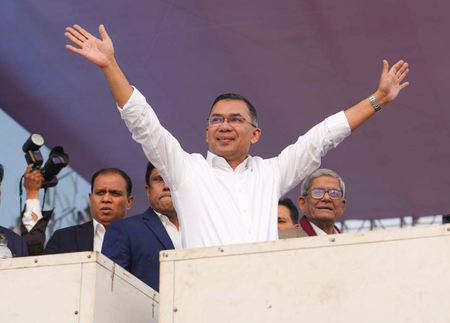
Washington, Feb 13 (IANS) US Secretary of State Marco Rubio, on Friday, congratulated the Bangladesh Nationalist Party (BNP) and its leader Tarique Rahman following their election victory, signaling Washington’s readiness to engage the new government in Dhaka.
“Congratulations to the Bangladesh Nationalist Party and its leader, Tarique Rahman, as well as the people of Bangladesh,” Rubio said in a post on social media platform X.
“The United States looks forward to working with the newly elected government to advance prosperity and the security of the region,” he added.
Rubio’s message came as senior administration officials emphasised Bangladesh’s strategic importance in South Asia during a US Congressional hearing earlier this week.
Testifying before the US House Foreign Affairs Subcommittee on South and Central Asia, Assistant Secretary of State for South and Central Asian Affairs Paul Kapur expressed optimism about the electoral process.
“We’re excited about it,” Kapur said.
“We’ve been in touch with the interim government. They’ve been — I think they have a strong sense of their responsibility in making this go forward in a way that is secure and peaceful.”
He added: “And we hope that, that is, in fact, what happens, we expect it will be. We look forward to working with, um, whatever government is elected there.”
Kapur also pointed to expanding economic ties between Washington and Dhaka.
“And two days ago, the Trump administration signed a trade deal with Bangladesh, providing American exporters with access to Bangladesh’s market of about 175 million people,” he told lawmakers.
Placing Bangladesh within a broader regional framework, Kapur said: “Bangladesh, Nepal, Maldives, Sri Lanka and Bhutan’s strategic locations afford them outsized importance, but they also can become targets for coercion.”
He stressed that US engagement aims to strengthen partners’ autonomy and resilience.
Defence cooperation with the United States, he said, “helps them to protect their borders and waterways against encroaching powers, and carefully targeted investment can provide these States with high quality, transparent, non-coercive support for critical infrastructure like ports, telecom networks and energy portals, helping them to avoid the dangers of debt trap diplomacy.”
–IANS
lkj/khz