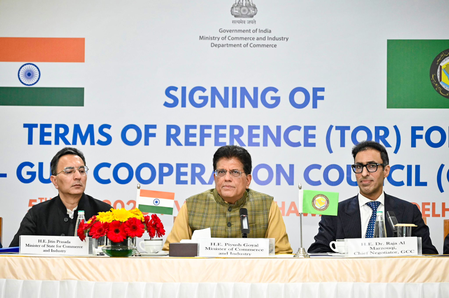
New Delhi, Feb 19 (IANS) The decision by India and the Gulf Cooperation Council (GCC) to formally restart negotiations on a Free Trade Agreement (FTA) after nearly fifteen years represents a significant geoeconomic inflection point between India and the Gulf states, as the relationship is no longer only energy-driven with the focus on geoeconomic realignments having assumed greater importance, according to a report.
The revival of these negotiations is not merely a trade event — it is a strategic signal. It reflects how West Asian nations are responding to a fragmented global order by expanding geoeconomic partnerships. In West Asia today, trade diplomacy is becoming a tool of strategic stability. The India–GCC FTA reset is a clear illustration of this transition, according to an article in India Narrative.
The Gulf states are undergoing structural transformation. Mega projects, sovereign wealth investments, and non-oil industrial expansion are redefining their economic models. Manufacturing, logistics, hydrogen energy, fintech, and advanced infrastructure have become central pillars of Gulf growth strategies. These shifts require deep integration with high-growth Asian markets, and India, with its labour force and technological capabilities, becomes indispensable, the article pointed out.
At the same time, New Delhi is also redefining its economic strategy. It is aggressively pursuing trade agreements to secure market access and integrate into resilient supply chains. Recent trade pacts, such as CEPA and FTAs, have demonstrated India’s willingness to engage in tariff rationalisation and regulatory alignment when strategic benefits outweigh protectionist concerns. The revival of these FTA discussions, therefore, reflects structural convergence, the article observes.
The earlier negotiations were stalled in 2008 amid disagreements over tariffs, petrochemical access, services mobility, and standards. But the geopolitical and economic context has vastly changed since then, paving the way for the talks to get going.
In the case of India, this FTA could significantly enhance export competitiveness in pharmaceuticals, agro-products, textiles, machinery, and IT services. Reduced tariffs and harmonised standards would lower barriers in a region where regulatory fragmentation previously constrained expansion. For the GCC nations, access to India’s consumer market and industrial base offers diversification leverage. Gulf sovereign wealth funds have already invested billions in Indian infrastructure, renewable energy, and start-ups. An FTA framework would institutionalise and protect such flows.
The agreement also intersects with India’s connectivity ambitions. The proposed India–Middle East–Europe corridor (IMEC) signals a shared interest in trade corridors linking South Asia to Europe via West Asia. In this scenario, this FTA could provide the legal and regulatory architecture underpinning these transport and logistics networks, the article added.
–IANS
sps/vd