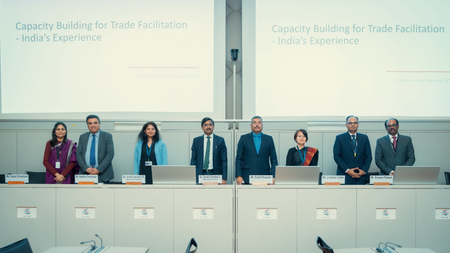
New Delhi, Feb 26 (IANS) The Central Board of Indirect Taxes and Customs (CBIC), along with the Permanent Mission of India to the WTO in Geneva, organised special sessions on trade on the sidelines of the meeting of the Committee on Trade Facilitation at the World Trade Organisation (WTO) in Geneva, according to an official statement issued on Thursday.
The event on Tuesday comprised two focused sessions on trade facilitation and capacity building, highlighting India’s transformative reforms under the WTO Trade Facilitation Agreement (TFA). The programme was also held in the run-up to the 8th Trade Policy Review of India, due in July 2026. The event witnessed wide participation from WTO Members and Secretariat, with delegates from around 40 countries, reflecting strong interest in India’s experience and best practices, the statement said.
Having achieved compliance with WTO TFA commitments, India has moved towards “TFA Plus” measures under the National Trade Facilitation Action Plan (NTFAP 3.0), aiming to go beyond the minimum requirements and align with evolving global best practices. During the session on Trade Facilitation, the Indian Customs delegation highlighted its ‘whole-of-government approach’ in Customs reforms, and pioneering efforts in creating a faceless, contactless and paperless Customs ecosystem through extensive digitalisation and process re-engineering.
India has notified 100 per cent of its TFA commitments within the stipulated timelines. The progress reflects India’s sustained commitment to enhancing transparency, improving inter-agency coordination and simplifying cross-border trade procedures.
The CBIC showcased its advanced and indigenously developed systems, including the comprehensive customs automated system with single window interface, a robust risk management system (RMS) and the authorised economic operator (AEO) programme.
The session on capacity building underscored India’s proactive engagement in sharing its expertise with developing and least-developed countries, particularly from the Global South. Through the National Academy of Customs, Indirect Taxes & Narcotics (NACIN), India conducts structured training programmes for officers of Indian and foreign customs administrations.
The training courses undertaken by the Central Revenue Control Laboratory (CRCL) of India for the international participants were highlighted. Both these are recognised by WCO as the Regional Training Centre for Asia-Pacific and the Regional Customs Laboratory, respectively. It was stated that, since 2022, NACIN has conducted 65 trainings, and more than 1,800 international participants from around 30 countries have benefited from these initiatives. Several of them were done in collaboration with various international organisations such as WCO, ADB and others.
Similarly, CRCL trained more than 300 international participants. India expressed its willingness to partner with countries, especially developing countries, to strengthen their capacity for implementing trade facilitation Agreement commitments. The participants appreciated the state-of-the-art infrastructure of these institutions and the training offered by the premier institutions of India.
The Special Secretary and Member (Customs), Surjit Bhujabal, remarked that India’s digitisation and modernisation of customs procedures over the past decade have contributed meaningfully to trade growth and deeper integration into global value chains. Indian Customs digital ecosystem connects traders, customs authorities, banks and logistics operators, facilitates electronic processing of customs documentation, leading to reduced transaction costs and faster clearance times.
–IANS
sps/vd