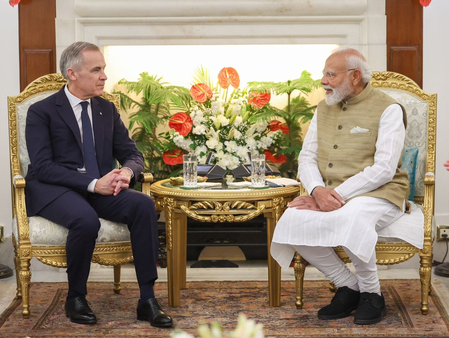
New Delhi, March 2 (IANS) Prime Minister Narendra Modi and Canadian Prime Minister Mark Carney, on Monday, set a year-end target to complete the negotiations for the Comprehensive Economic Partnership Agreement (CEPA) between the two countries and agreed to deepen bilateral collaboration in the energy and critical mineral sectors.
“The two leaders welcomed the conclusion of a CAD $2.6 billion commercial agreement between Cameco and the Department of Atomic Energy for the long-term supply of uranium, contributing to India’s civil nuclear energy generation, clean energy transition objectives, and long-term energy security,” according to a joint statement issued after the summit.
Recognising their complementary strengths as energy powers, the two leaders agreed to advance the India-Canada Strategic Energy Partnership aimed at deepening long-term cooperation across the energy value chain.
“They underscored the shared commitment to enhancing collaboration across clean energy, conventional energy, civil nuclear energy, and critical minerals to promote affordability, sustainability, and economic growth,” according to a joint statement issued after the summit.
The leaders noted that strengthened institutional engagement would support expanded bilateral energy trade, including in liquefied natural gas (LNG), liquefied petroleum gas (LPG), crude oil, refined petroleum products, potash, and uranium supply offtakes.
New Delhi and Ottawa hope to increase bilateral trade to $50 billion by 2030, Indian Prime Minister Narendra Modi said during a joint media conference with his Canadian counterpart Carney, from nearly $9 billion in 2024-25.
Both sides acknowledged the significant potential to further expand bilateral energy trade. This includes increased oil and LNG imports by India from Canada, as well as the supply of refined petroleum products from India to Canada.
In this context, Canada reaffirmed its plans to expand heavy oil export infrastructure and supplies of LNG to the Indo-Pacific market through Canada’s stated goal of producing 50 million tonnes of LNG per year by 2030 and up to 100 million tonnes by 2040.
The two leaders welcomed discussions between Indian public sector oil and gas companies and Canadian energy firms to expand bilateral cooperation in LPG.
Both sides also reaffirmed support for greater private investment flows and long-term offtake arrangements including through tools, such as loans, financing, and equity investments to support commercially viable energy partnerships.
The two leaders underscored their commitment to deepening long-term, reciprocal investment partnerships across the energy and natural resource sectors, recognising the scale of ongoing projects and emerging opportunities in both markets.
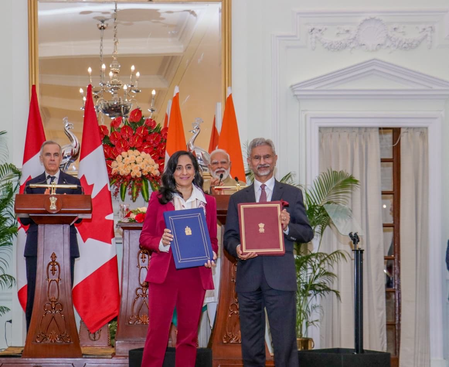
They further welcomed the signing of a Memorandum of Understanding on critical minerals cooperation, reflecting their shared commitment to building resilient, secure, and diversified critical minerals supply chains.
The two leaders agreed to strengthen collaboration in investment to support clean energy technologies and future-oriented industries.
They agreed to deepen cooperation on critical minerals and energy transition pathways, including exploring collaboration on helping to secure India’s mineral stockpiling initiative, and supporting robust commercial outcomes for Canadian and Indian companies, while also sharing expertise on emissions reductions, and transition technologies.
The leaders also welcomed the signing of a Memorandum of Understanding on Clean Energy Cooperation, establishing a comprehensive institutional framework to advance bilateral collaboration across solar, wind, bioenergy, small hydro, energy storage, and capacity-building.
Canada expects to double electricity supply by 2050 and significantly expand deployment of renewable energy and energy storage.
The two leaders discussed the urgency and mutual benefit of strategic partnership on space cooperation by respective agencies and private sectors.
Building upon space cooperation, India and Canada intend to explore joint initiatives to integrate AI into space and aerospace technologies.
By co-developing these AI tools for space applications and earth observation, both countries will advance innovation and reinforce their technological sovereignty.
The two leaders also agreed to explore collaboration on AI-assisted tools to strengthen the diagnostic capabilities of distance medicine to deliver modern, reliable healthcare to the remote regions of both countries.
Besides, recognising the growing complementarity between India and Canada in agriculture and agri-food systems, the two leaders underscored the importance of strengthening cooperation to enhance food security, farm productivity, and resilient supply chains.
–IANS
sps/khz