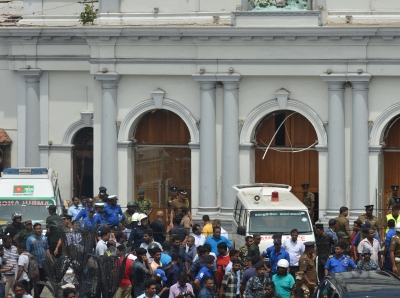
New Delhi, April 1 (IANS) The fall of the National Thowheed Jamath (NJT), which masterminded the 2019 Easter bombings in Sri Lanka, came as a major relief for the security agencies. The NJT had not only spread its ideology in Sri Lanka, but was active in the southern states, especially in Tamil Nadu. While the NJT remains largely defunct today, the agencies are keeping close tabs on operatives linked to the outfit, prior to its fall.
Intelligence inputs suggest that some former operatives are looking to revive the NJT and keep the focus largely in South India.
Officials say that these operatives realise that they cannot operate any more on the scale that the NJT used to. However the intention is to form small groups and indulge in radicalisation activities.
States such as Kerala and Tamil Nadu have been prone to radicalisation for long and the former cadres are seeking to take advantage of this.
The NJT has an old connection with South India. Its founder Bahrain Hashim had big plans and had visited Tamil Nadu several times. He managed to radicalise a large number of youth.
Jamesha Mubeen the mastermind of the car bomb explosion near the Sangameshwar Temple in Coimbatore was closely linked to Hashim.
The car bomb exploded on October 22, 2022 and the National Investigation Agency (NIA) had said that Mubeen had looked to replicate the 2019 Easter Bombings in South India.
An Intelligence Bureau official says that there are many who want to fill the vacuum that was left by the Popular Front of India (PFI). The PFI was banned by the Modi government and since then the outfit has remained silent.
Although attempts of revival are being made, they have so far not been successful. Operatives linked to the NJT are looking to take advantage of that vacuum and undertake radicalisation drives.
The agencies say that these operatives remain in touch with the members of the Islamic State, which has a considerable amount of traction in South India. Hashim, prior to his death and during his peak, had openly supported the Islamic State and even sought to carry out operations with the group in Sri Lanka.
Moreover the NJT and Islamic State share a common objective and ideology and hence the operatives of both groups are capable of working together. Those linked to the NJT, who remain out in the open, will look to seek the help of the Islamic State as well as former PFI members to set up small scale operations.
Another official said that these persons are not looking to set up bigger modules. Their aim is to carry out a quiet operation in towns, cities and villages, that is aimed only at radicalisation. The are trying to form smaller groups and provide them with a target audience to radicalise.
While this appears to be a smaller operation, if left unchecked it could turn into a major menace, another official said.
What these people aim to do is make this into a movement. Like is expected in the case of lone wolf actors who carry out terror attacks on their own, these elements are attempting something similar.
They realise that working as a group can catch the eye of the agencies easily. They intend having a large number of groups which have not more than three people to go around and spread a radical ideology, the official explained.
The intention is to radicalise a large number of youth so that going forward they would act on their own and continue the process.
The agencies warn that the attempt is to turn into a silent mass movement so that the number of people who are radicalised are high in number.
Such acts are aimed at changing the mindset of the people and this is a lurking danger that the agencies are trying to prevent.
–IANS
vn/rad