New Delhi, March 22 (IANS) Pakistan is among the countries included in the ‘Board of Peace’, reportedly formed by US President Donald Trump to explore lasting peace solutions in the Gaza Strip. However, the country’s own record of religious persecution and alleged ‘nurturing’ of terror on its soil has raised concerns about its ability to play peacemaker in a region marred by intense hostilities over the past two years.
A report by the Gatestone Institute has highlighted a series of incidents inside Pakistan that expose its poor record in protecting religious minorities, to the extent that it qualifies as one of the “most dangerous countries” for Christians and other non-Muslims.
It states that last year was marked by a deepening crisis for religious minorities in Pakistan, with rising mob violence and a climate of “near-total impunity for perpetrators”.
“Christians, Hindus, and other non-Muslim minorities faced a combination of physical attacks, forced displacement, and structural exclusion. The Christian community remained particularly vulnerable to accusations of blasphemy that rapidly escalated into collective punishment, with mobs burning churches, targeting homes, and destroying livelihoods in affected neighbourhoods,” the report said.
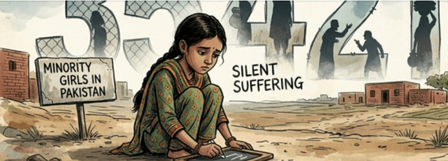
Incidents of forced religious conversions, abductions of Hindu girls, and coerced marriages are widely reported. For the affected families, there is often little legal recourse, compounded by victim intimidation and alleged bias within the state machinery.
Citing another case, the report states that a 21-year-old Christian farmworker, Marcus Masih, was allegedly tortured to death by his Muslim employers in Pakistan’s Punjab Province, with the incident subsequently labelled as a suicide by hanging.
The incident, which drew global attention, was followed by the United States Commission on International Religious Freedom (USCIRF) urging the US government to redesignate Pakistan as a “Country of Particular Concern” (CPC) over systematic and ongoing violations of religious freedom.
Listing other incidents of violence against minorities, the report notes that in March 2025, Zohaib Iftikhar allegedly slit the throat of his co-worker, Waqas Masih, a 22-year-old Christian, accusing him of committing blasphemy by touching an Islamic textbook with “unclean hands”.
In May 2025, Christian labourer Kashif Masih was reportedly tortured to death by a group of men, including a former police officer, over an unproven allegation of theft, sparking outrage among minority groups.
In June 2024, 18-year-old Catholic worker Waqas Salamat was allegedly tortured to death by his employer and others for reportedly leaving his job without permission. His family said he was subjected to hours of electric shocks that proved fatal.
Further citing incidents of forced conversions among Hindu and Christian girls in Punjab and Sindh provinces in 2025, the report states that the year also saw multiple attacks on places of worship.
It also mentions the case of a 12-year-old Christian girl, Saba Shafique, who was reportedly abducted in Sindh Province, forcibly converted to Islam, and then married to a 35-year-old man, Muhammad Ali.
Making a strong case for the exclusion of Pakistan from the ‘Board of Peace’, the report argues that the country would be an unlikely contributor to any credible peace-building mechanism.
–IANS
mr/pgh