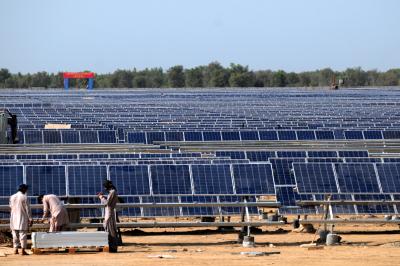
New Delhi, April 11 (IANS) China’s push to become a global supplier of renewable energy technology is drawing sharp criticism from Africa, South Asia and Latin America, alleging Chinese solar panels, wind turbines and batteries to be low‑quality and poorly suited to local conditions, a new report has said.
The report from Nepal Aaja also argued that these projects are also tied to financing that creates long‑term dependencies.
“China’s financing model typically ties loans to technology imports, meaning countries that accept Chinese funding are compelled to purchase Chinese equipment. Once locked into these supply chains, recipient nations find themselves dependent not only on Chinese hardware but also on Chinese spare parts, technicians, and after-sales services,” the Nepal-based media house said.
China’s RE exports gain strength from state-subsidized overcapacity, designed to absorb domestic surplus but they fail to meet the long-term needs of recipient nations. “The result is a wave of underscale technology—cheap upfront, but expensive in maintenance and replacement,” the report said.
Recipient nations of Chinese equipments in Africa and Southeast Asia have complained of frequent breakdowns, short lifespans with panels failing to withstand local climatic conditions, undermining electrification projects.
“Grid integration has proven inefficient, leading to costly repairs and delays in electrification projects. In Latin America, wind turbines imported from China have been criticized for their short lifespan compared to European alternatives,” the report noted.
China tries to position itself as the indispensable supplier of renewable technology, but the real aim is to lock the Global South into its orbit, creating asymmetric dependencies, with almost nil technology transfer.
“This dependency undermines their ability to hedge strategically in a multipolar world. Nations that might otherwise balance ties between China, the West, and regional powers are constrained by their reliance on Beijing’s energy ecosystem,” it said.
Leaders in Africa and Latin America called the relationship with China as a form of neo‑mercantilist exploitation in which energy ties are used to secure broader political concessions. China used the leverage to its advantage in UN voting alignment, Belt and Road expansion, and bilateral trade negotiations.
–IANS
aar/na