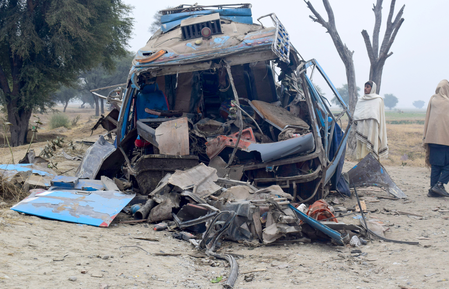
Islamabad, April 12 (IANS) Terrorist barbarity continues in Pakistan as the authorities’ approach to the issue is mainly being reactive instead of proactive and efforts have rarely been made to remove the root causes and drivers of terrorism, according to a report.
Only military operations cannot deter terrorist attacks, as kinetic gains fail to address the drivers and root causes behind terrorism in Pakistan, the report in Greece-based Directus noted.
Pakistan has been ranked at the first spot on the Global Terrorism Index, recording a rise of 6 per cent in terrorism-related deaths, according to the report published by the Institute for Economics and Peace last week. In 2025, Pakistan ranked in the second spot on the Global Terrorism Index; however, it had witnessed a rise in the number of deaths in terrorist attacks by 45 per cent over the past year.
According to the report, the Taliban’s return to power in Afghanistan has provided Tehreek-e-Taliban (TTP) “with the means and motivation to significantly expand their geographic reach and operational efficiency, resulting in a considerable rise in violent extremism in the region”. In February, Pakistan launched ‘Operation Ghazab lil-Haq’ (Righteous Fury) in response to what it described as “unprovoked firing” by the Afghan forces across multiple border sectors.
“Yet, our very own war on terror has proven time and again that military operations alone are not an effective and sustainable strategy to deter terrorist attacks, as kinetic gains fail to address the drivers & root causes behind terrorism. With our approach primarily being reactive rather than proactive and efforts rarely being made to effectively remove the root causes and drivers of terrorism, terrorist barbarity resurfaces repeatedly in the country, every time more forcefully than before, eventually having pushed Pakistan to the top of countries ravaged by terrorist onslaughts,” it said.
Political polarisation in Pakistan and the US-Iran war are factors that may further deteriorate the threats of terrorism that Pakistan faces. However, old and inherent issues of political instability, swift change in policies and the change in power every now and then, have increased terrorism in Pakistan.
“Sectarian violence, lack of education, escalating poverty, a tattered social fabric and polarisation in the society are factors that have stoked the fire of terrorism for decades. All these factors have a correlation to extremism, the foundation of ever emerging waves of terrorism in the country: the unmanaged madrasa culture, flaws in policy making and economic vulnerability to tackle extremism and create effective counter-terrorism policies,” the report said.
According to the Global Terrorism Index report 2026, Khyber Pakhtunkhwa and Balochistan were most impacted by terrorism, accounting for more than 74 per cent of terrorist attacks and 67 per cent of deaths in 2025. The report highlighted the need for Balochistan reconciliation and similar settlement plans, not only to deter terrorist attacks but also to improve Pakistan’s ranking on the Global Terrorism Index.
“With the TTP having emerged as the ‘deadliest’ terror group in Pakistan and the third deadliest globally, Pakistan has witnessed a substantial rise in terrorism that has shot it up to the top, despite a global ‘substantial fall’ in incidents of terrorism. Globally, the number of attacks has decreased by nearly 22 per cent, while deaths from global terrorism have fallen by 28 per cent, according to the GTI report. Pakistan needs to combine kinetic approaches with non-kinetic efforts to counter the monster of terrorism.”
–IANS
akl/vd