
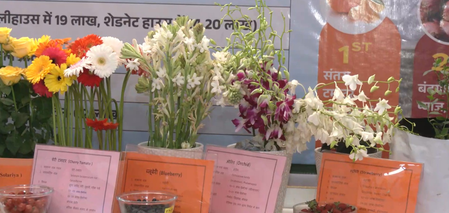
Bhopal, April 13 (IANS) A three-day Advanced Agriculture Festival is currently underway in Raisen district of Madhya Pradesh, piquing the interest of a wide cross-section of farmers from across the country.
A raft of agricultural innovations and modern practices is on display, showcasing and informing farmers about the need to adopt and introduce them in daily farming. Many farmers, expressing a willingness to embrace change with the times, explored modern agricultural machinery, new technologies, and advanced farming methods on display at the fair.
Notably, Indian agriculture is rapidly modernising, with farmers moving beyond traditional methods and adopting technology-enriched practices to enhance field productivity.
The Centre and state governments have taken the task of this ‘transition’ at an urgent pace and are also informing farmers about various schemes and programs from which they can reap benefits.
The National Horticulture Board (NHB) is running special schemes to encourage horticulture, under which farmers are provided financial assistance for the cultivation of fruits, vegetables, flowers, spices, and medicinal and aromatic plants.
Additionally, farmers are also being familiarised with advanced techniques through specialised training programs.
Devaki Markam, Senior Horticulture Development Officer for Begumganj, speaking to IANS, said that small farmers are becoming self-reliant through the ‘PM Formalisation of Micro Food Processing Enterprises’ (PMFME) scheme.
Under the PMFME scheme, eligible beneficiaries receive a 35 per cent subsidy on project costs for the establishment or expansion of food processing units. This initiative is also creating new employment opportunities in rural areas.
Sundar Kantia, Deputy Director (NHB), said that the farmers are being provided with a subsidy of up to 50 per cent for the construction of protected cultivation structures, such as polyhouses, greenhouses, and shade nets.
Also, financial assistance of up to 40 per cent is available for open-field cultivation of crops such as mango, guava, and amla (Indian gooseberry).
Furthermore, subsidies ranging from 30 to 50 per cent are available for cold storage facilities, pack houses, and other post-harvest infrastructure.
A subsidy of up to 40 per cent is also being provided to promote mushroom production.
Another such program is the National Horticulture Mission, under which farmers are provided with a subsidy of 40 to 55 per cent — via Direct Benefit Transfer (DBT) — for adopting drip irrigation, high-quality planting material, and modern technologies. Special incentives are offered for new crops, such as dragon fruit.
–IANS
mr/dan