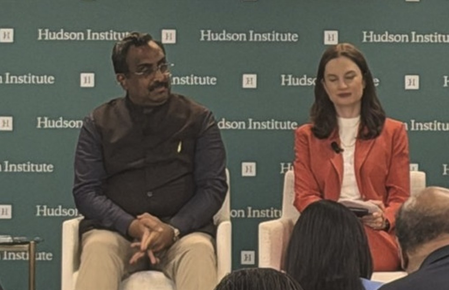
Washington, April 23 (IANS) India and the United States must rebuild “mutual respect, mutual sensitivity” and align on core interests as their relationship undergoes a “stress test” amid geopolitical shocks and economic frictions, speakers said at a high-level panel at the Hudson Institute.
The discussion, part of the New India Conference, highlighted strains across strategic, economic and people-to-people pillars, even as participants stressed that the partnership remains durable and essential.
Ram Madhav, president of the India Foundation, said the relationship, though “very important” and “lasting,” is facing visible stress across its foundational pillars. “We had a great understanding of our geostrategic priorities… Today doesn’t seem so anymore,” he said, pointing to divergence over China and broader strategic clarity.
He said the economic pillar has also weakened, citing trade tensions and investment imbalances. “We are also facing net negative FDI from… the US on the economy,” he noted, while expressing hope that an upcoming trade deal could stabilise ties.
On the diaspora, Madhav warned of “a lot of anxiety, a lot of worries” among Indian-origin communities in the United States, underscoring the importance of people-to-people ties that have historically reinforced the partnership.
He called for recalibration anchored in “mutual respect… mutual sensitivity… and mutual interest,” adding that “it’s not enough to be goody goody about the things… it is important to really look at what is happening.”
Elizabeth Threlkeld of the Stimson Centre said the past year had effectively put the relationship through a “stress test,” but noted that it had not “come to a screeching halt.” She pointed to continued cooperation in defence, energy, space and supply chains, even amid reduced high-level engagement.
She said economic ties, including major investments by US technology firms, provide “ballast” to the relationship. India’s response to shifts in Washington, she added, has been “remarkably measured and mature,” describing its outreach to other partners as “incremental calibration rather than any sort of fundamental shift.”
Threlkeld also flagged immigration and visa uncertainty as critical to both business and people-to-people ties, while cautioning that the shared democratic narrative underpinning the relationship has “less traction than it used to.”
Kurt Campbell, former US Deputy Secretary of State, described the relationship as “the most important… for the United States in the 21st century,” but acknowledged rising unease. “It is troubling… that we have to have a reminder around mutual respect,” he said.
Campbell highlighted the resilience of diaspora ties, recalling the rapid mobilisation of Indian-American communities during the Covid crisis. He also underscored the importance of expanding education and technology partnerships, noting strong demand among Indian students and professionals.
He warned, however, that bureaucratic and strategic misalignment within the US system continues to complicate engagement with India, particularly in defence structures spanning multiple regions.
On the ongoing global conflict impacting the Indian Ocean, speakers expressed concern over its widening scope. Madhav said the expansion of conflict into the “entire Indian Ocean region” was “certainly a matter of big concern” for India, stressing the need for “negotiation” and “dialogue.”
Threlkeld said the crisis has exposed vulnerabilities in supply chains, energy security and maritime operations, calling for deeper cooperation in logistics, intelligence sharing and contingency planning.
Campbell warned that the conflict’s long-term economic and military consequences would be “greater… than anyone is really ready to acknowledge,” particularly for the Indo-Pacific, as US resources shift away from the region.
The New India Conference, held on April 23 at the Hudson Institute, brought together senior policymakers, strategists and analysts to assess India’s evolving global role and the future of US-India ties.
–IANS
lkj/dan