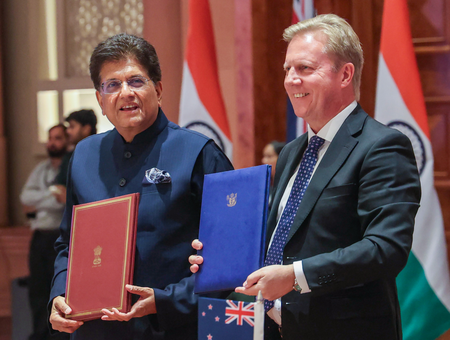
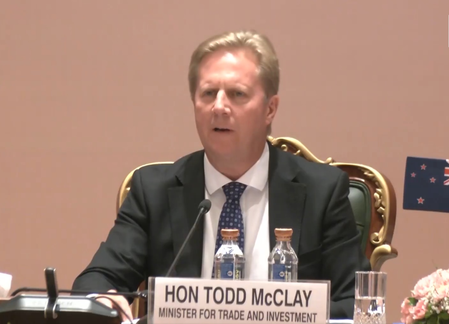
New Delhi, April 27 (IANS) New Zealand’s Minister for Trade and Investment, Todd McClay, said that the FTA signed with India on Monday will be put before his country’s Parliament as early as tomorrow to fast-track the process so that it can come into force within this year.
“We will start very, very quickly. We hope to have it enter into force before the end of the year, and then it will be fully implemented over about a seven-year period. Over the next few months, we will all be working very hard. We want the benefits of the deal to be available to all citizens of India and New Zealand,” the minister said in an exclusive interview to IANS.
“On day one, all exports from India to New Zealand will have a zero tariff rate. For many of our exports, over 50 per cent will drop to zero tariffs on day one, while in other areas, it will be implemented over the next seven years. By then, about 95 per cent of what New Zealand exports will either be tariff-free or have significant tariff reductions,” McClay pointed out.
Asked how the FTA would help accelerate economic growth across the spectrum, especially amid the ongoing global uncertainty, the minister said that a free trade agreement creates a common set of rights and obligations that businesses can rely upon.
He said that the FTA represents a public commitment by India and New Zealand to create rules and honour them, which will give business communities confidence that if they invest time and effort into this trading relationship, they will have certainty. This is very important because the global trade environment is quite uncertain at the moment, he added.
“This agreement serves as a beacon, a bright light that shows how negotiating high-quality agreements and honouring commitments can help economies grow, which ultimately benefits our citizens,” McClay observed.
He further stated that the FTA would benefit sectors across the board. For Indian exporters to New Zealand, there are very few restrictions and a zero tariff rate. India produces a wide range of goods from agricultural equipment to chemicals, fertilisers, and possibly oil products. Even more importantly, many manufactured goods from India can find their way into New Zealand. New Zealand consumers are selective; they value both competition and choice, so India is likely to perform very well, he added.
He further stated that from New Zealand’s side, there are many complementary sectors. New Zealand produces some of the highest-quality and safest food in the world. In areas where India relies on imports, such as lamb, seafood, and certain horticultural products that will see increased supply.
For Indian consumers, this means more choice, potentially better prices, and a strong guarantee of quality. If it comes from New Zealand, it is safe, delicious, and enjoyable, the minister added.
–IANS
sps/vd