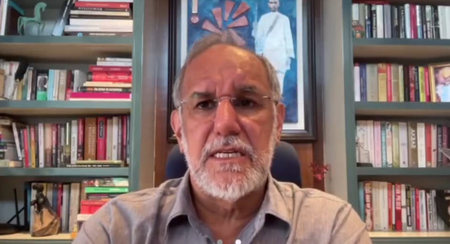
New Delhi, April 30 (IANS) Iran and the US’s blockage of the Strait of Hormuz is “illegal, and the breakdown of the rule of law and rules-based order”, India’s former Ambassador to the UAE and Egypt Navdeep Singh Suri said on Thursday.
In an interview with IANS, Suri stated that the recent developments in West Asia have a direct impact on the Indian economy. He called for seeing Strait of Hormuz going back to the status it enjoyed prior to February 28, when the US and Israel attacked Iran.
On how he assesses India’s role in the Iran-US war, he said: “We are obviously very concerned about the developments. We are seeing that they have a direct impact on the Indian economy. From our perspective, I think, speaking at a very personal level, I think that you are seeing multiple breakdowns of the rule of law, of the rules-based order. The US and Israeli attack on Iran was illegal. Iran’s attack on its neighbours as a retaliatory step was illegal. Iran’s blockage of the Strait of Hormuz is illegal, and the US blockading the blockage is illegal. So, I think, know, we really, we should be as a major country in the neighbourhood, we should be very concerned about this kind of lawlessness or a might-is-right policy that various countries in the region are adopting.”
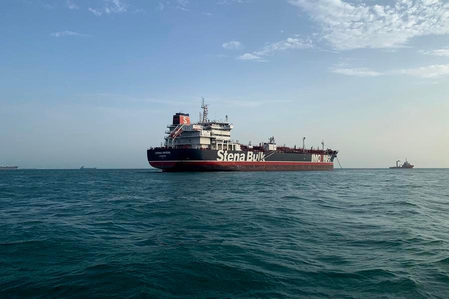
The tensions in West Asia escalated after the US and Israel carried out a joint military operation against Iran on February 28. The joint military strikes killed Supreme Leader, Ayatollah Ali Khamenei, triggering a large-scale military operation by Iran against Israel and the US bases in the Gulf nations. The conflict also led to the closure of the Strait of Hormuz, which triggered a global energy crisis.
Iran and the US reached a two-week ceasefire starting on April 8. Later, the two nations held the first round of talks on April 11-12 aimed at ending the conflict. However, the talks collapsed after 21 hours of negotiations.
Asked about how he assesses the current situation in the conflict in West Asia, the former envoy said: “If you are looking at purely a military perspective, then obviously, the US is a superpower by any definition. Israel is the regional superpower if the US is the global superpower, and when the two of them together attack a country like Iran, which has been under sanctions for 47 years, it doesn’t take a genius to guess that the military result will definitely be in favour of the US and Israel. But, beyond the battle that has been fought is the larger war, and I think that Iran, by virtue of executing its stranglehold on the Strait of Hormuz, has won a lot of tactical victories. So, at this point, I would say that strategically Iran seems to be the greater beneficiary or seems to be ahead, whereas tactically the US has won the military victories.”
He stated that Iran, due to the conflict, has become aware of the leverage it holds by virtue of its chokehold on the Strait of Hormuz and urged India and other nations to act in concert so that the situation would be as it was before February 28.
On the future of the Strait of Hormuz, he said: “I would love to see the Strait of Hormuz going back to the status that it enjoyed before the 28th of February, when the US and Israel attacked Iran, which means that it was an international waterway lying between Iran and Oman, and ships could go back and forth freely in an unrestricted manner. But, I think what this war has done is that it’s made Iran aware of the leverage that it enjoys by virtue of its chokehold on Hormuz and having realised the tremendous global impact that this control has, I think Iran might be reluctant to give it up. So, you may see a different regime come into place where there’s some form of tacit acknowledgement of Iranian, not sovereignty, but a degree of control going forward. I do not know what form or shape it will take, certainly, if you look at the UN Convention on the Law of the Sea, it treats these international waterways in a certain fashion, and it is illegal for any country to restrict access or to apply tolls. But as I said, you are looking at a completely new situation.”
“You are seeing a breakdown of international law and Iran is not a signatory to the UN Convention on the Law of Sea, nor is the United States for that matter and so both of them are acting in unilateral ways and so I’m concerned that Iran may end up controlling the Strait of Hormuz in a way that it is either able to apply tolls or management fees or maintenance charges or some other form of taxation that raises the cost of shipping for a country like India, which imports so much of its stuff from the Gulf and which exports, the Gulf is also a major market for Indian exports. So, I think we will end up as one of the losers.”
“I think the second dimension of this is that it is also giving ideas to other countries that have a dominant position across a narrow waterway. I’ve seen the remarks of the Indonesian minister, for example, about the possibility of applying a toll on the Strait of Malacca, which is again one of the world’s busiest waterways. Now, to start with Singapore and Malaysia, which are the two other countries across the Strait, have opposed such thinking but the genie is out of the bottle and I don’t see how we are going to go back to a pre-February 28 situation unless many of the large countries, the middle powers, the Europeans, India, Australia, others, act in concert,” he added.
Suri expressed support for Defence Minister Rajnath Singh’s statement that terrorism has no nationality or religion.
“I agree with it. I think terrorism has no nationality. You have seen cases of international terrorism emanating from multiple countries around the world, across multiple religions. No country, religion or movement seems to have a monopoly on terrorism. Obviously, we are traditionally very concerned about terrorism that has emanated from Pakistan, but that’s hardly the only source of terrorism globally, and there are enough examples to be seen from Hamas in Gaza to the Hezbollah in Lebanon to the Irish Republican Army in the old days or to the Basque in Spain or what’s happening in various countries in Africa today. So, I think it would be reasonable to say that terrorism has no religion; it also does not have a particular geography.”
In his recent remarks at the Shanghai Cooperation Organisation (SCO) Defence Ministers’ Meeting, Rajnath Singh stated that terrorism has no nationality or theology and urged the international community to take a “firm and collective stance against terrorism”.
Asked whether Rajnath Singh’s statement has damaged India’s stand labelling Pakistan as the originator of terrorism and stand against Islamic terrorism, Suri said: “No, I don’t think so. As I said, why should we think that terrorism is only Islamic? Aren’t there Christian terrorist groups? Aren’t Jewish terrorist groups? Aren’t there others around? You have enough examples of that, surely. So, this notion of trying to attach the tag of terrorism to a religion, I think, is fundamentally flawed. And if Pakistan has used terrorism in the past, it is not just the religious angle; it is also Pakistan’s strategic approach to try to use these terrorist groups to target India. And I think religion is only one of the factors at work. How can we ignore the very real fact that whether it is Catholics or Protestants, whether it is Jews in certain parts of the world, whether it is Shias, whether it is Buddhist in the case of Sri Lanka. You have enough examples of various terrorist groups from different religions.”
–IANS
akl/vd