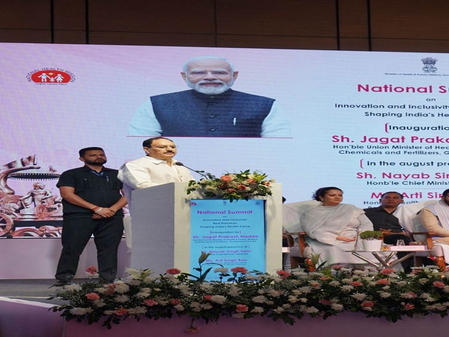
New Delhi/Chandigarh, April 30 (IANS) Highlighting the transformative shift to holistic healthcare under Prime Minister Narendra Modi, Union Minister of Health and Family Welfare J.P. Nadda on Thursday inaugurated a national summit showcasing path-breaking innovations and best practices in the health sector.
Speaking at the 10th National Summit on Innovation and Inclusivity: Best Practices Shaping India’s Health Future in Chandigarh, J.P. Nadda reflected on India’s healthcare transformation over the past decade.
He said that under the guidance of Prime Minister Narendra Modi, the country has made significant strides towards the vision of Viksit Bharat.
A key milestone in this journey has been the shift from a predominantly curative approach to a comprehensive and holistic healthcare framework, he said.
He highlighted that while the earlier National Health Policy of 2002 focused largely on curative care, the National Health Policy 2017 brought a paradigm shift by incorporating preventive, promotive, curative, and palliative aspects of healthcare, thereby ensuring a more inclusive and people-centric system.
The Minister underscored the critical role of over 1.85 lakh Ayushman Arogya Mandirs, which now serve as the first point of contact for nearly 1.5 billion people.
These centres have significantly strengthened preventive healthcare, including large-scale screening for non-communicable diseases such as hypertension, diabetes, and cancers (oral, breast, and cervical) for individuals above 30 years of age.
The Union Health Minster stated that institutional deliveries have increased from 79 per cent to 89 per cent, reflecting improved access to maternal healthcare services.
Maternal Mortality Ratio has seen a significant decline, with sustained progress over the years. Citing recent global estimates, the Minister noted that India has achieved a 79 per cent decline in under-five mortality and a 73 per cent decline in infant mortality.
He highlighted India’s progress in disease control, stating that despite having nearly one-sixth of the world’s population, India accounts for only a small fraction of the global malaria burden. Similarly, tuberculosis incidence in India has declined at a faster rate than the global average, with treatment coverage reaching 92 per cent.
Haryana Chief Minister Nayab Singh Saini and Health Minister Arti Singh Rao were also present on the occasion.
The Summit serves as a premier platform for States and Union Territories to showcase path-breaking innovations and best practices in the health sector, with a focus on advancing inclusive, accessible, and affordable healthcare across the country.
J.P. Nadda commended the state for its leadership in advancing healthcare innovations, noting that the Summit reflects how practical, field-driven strategies can collectively shape an effective and responsive public health ecosystem.
Highlighting the significance of the initiatives launched on the occasion, the Minister stated that these interventions are designed to ease the working environment of frontline healthcare workers while enhancing service delivery and improving health outcomes.
The focus, he emphasised, is on enabling systems that are efficient, integrated, and responsive to the needs of both providers and beneficiaries.
–IANS
rch/pgh