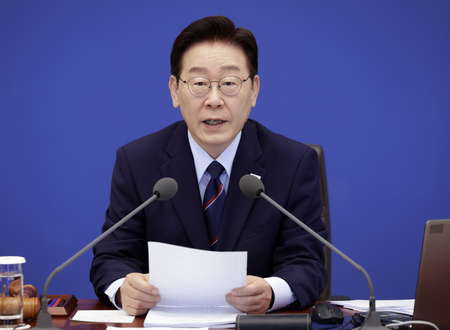
Seoul, May 26 (IANS) South Korea’s President Lee Jae Myung on Tuesday instructed officials to accelerate efforts to fulfil South Korea’s plan to acquire nuclear-powered submarines.
The president made the call during a Cabinet meeting, highlighting the need to enhance the country’s self-defence capabilities amid North Korea’s growing nuclear and missile threats.
In a fact sheet released after a South Korea-US summit late last year, Washington expressed support for Seoul to build nuclear-powered, conventionally armed attack submarines, and to pursue civilian uranium enrichment and spent fuel reprocessing for peaceful purposes, Yonhap news agency reported.
“We need to accelerate the adoption of artificial intelligence and drone technologies, while speeding up the introduction of nuclear-powered submarines, which are core strategic assets for future defence capabilities,” Lee said.
While presiding over a defence strategy committee meeting in South Gyeongsang Province later in the day, Lee described the envisioned submarines as “a symbol of our will to take responsibility for peace and security on the Korean Peninsula on our own.”
During the committee meeting, Defence Minister Ahn Gyu-back outlined Seoul’s plan to launch the first batch of nuclear-powered submarines in the mid-2030s before putting them into service in the late 2030s or later.
During the Cabinet meeting, Lee also stressed the need for the swift transfer of wartime operational control (OPCON) of South Korean troops from Washington to Seoul.
The president insisted that “friends will respect us and alliances will be maintained more strongly” when the country demonstrates its determination to defend itself, calling for the transfer of OPCON in a swift and timely manner.
Regaining wartime OPCON from Washington is a key policy pledge of Lee, who seeks to complete the transfer during his five-year term ending in 2030.
South Korea handed over operational control of its troops to the US-led UN Command during the 1950-53 Korean War. It was then transferred to the Combined Forces Command of South Korea and the United States when it was launched in 1978. South Korea retook only peacetime operational control in 1994.
At Tuesday’s meeting, Lee also called for all-out efforts to turn the military into a “powerful, future-oriented and cutting-edge” force, stressing the need to upgrade defence capabilities amid what he called the “harsh reality” of the international community where power takes precedence.
“Currently, our defence capabilities are sufficient to defend the country on our own, but they should be strengthened further in the face of the harsh international reality,” the president noted.
The president also called for efforts to strengthen the country’s “K-defence” industry and foster new defence companies to lead global markets in the robotics, drone and space sectors, while stressing the need to solidify multilateral diplomacy.
“It would be very important to work toward building peace so as to prevent wars from breaking out,” Lee said, emphasising the importance of fostering multilateral security networks.
Turning to other issues, Lee urged thorough government efforts to push ahead with a plan to establish a global maritime hub in the country’s southeastern coastal region, saying it would hold special geopolitical value amid increasing regional competition for maritime leadership.
With the goal of expanding Arctic shipping routes, the oceans ministry seeks to transform the southeastern city of Busan and its surrounding area into a global maritime hub. As part of the initiative, several shipping firms and the ministry itself have relocated their headquarters to Busan, the largest port city in the country.
“The southeastern region has sufficient potential to grow into a global maritime economic hub,” Lee said, pledging to expand sea and air port infrastructure, the maritime industrial base, and related facilities to help realise the initiative.
The president also called for the profitable operation of a government-led investment vehicle, known as the “public growth fund,” to ensure higher returns for investors.
The fund has been launched to raise 150 trillion won (US$99.5 billion) from individual investors and state finances over the next five years to invest in the country’s advanced industries, including semiconductors, defence manufacturing and biotechnology.
The president noted the country’s shifting economic structure is likely to widen wealth and income gaps, expressing hope that the fund could help slow the growing disparity.
–IANS
ksk/as