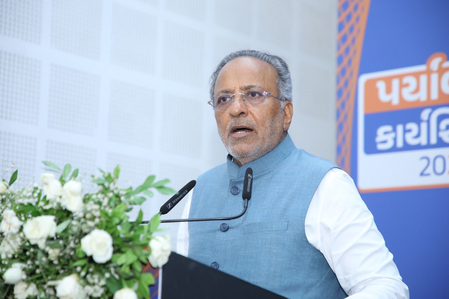
Gandhinagar, June 7 (IANS) Gujarat Forest and Environment Minister Arjun Modhwadia said on Sunday that ensuring sustainability alongside development and minimising the use of natural resources remained a priority for the state, as he addressed the closing session of a two-day environmental workshop organised jointly by the Forest and Environment Department and the Gujarat Pollution Control Board (GPCB) in Gandhinagar.
Addressing the session, chaired by Modhwadia and Minister of State for Forest and Environment Pravin Mali, the Minister said the GPCB would play the most crucial role in the state’s efforts to become pollution-free.
“GPCB’s role is going to be the most decisive in making Gujarat pollution-free. Ensuring sustainability alongside development and minimising the use of resources is our priority,” Modhwadia added.
He said the Board and the Department had consistently been at the forefront of taking corrective measures and that coordinated efforts were being made to ensure industries continued to operate while pollution levels remained as low as possible.
Modhwadia added that the Board would have an important role in expanding incentives for compliance with environmental regulations and said that the discussions held during the workshop would prove valuable in shaping the state’s future environmental vision.
“The Chintan Shibir will be very useful for future vision planning. Based on the Vision Plan, departments such as Urban Development, Industries, Transport and Water Resources will now be able to prepare their own action plans,” he said.
Calling for a collaborative approach between regulators and industry, the Minister urged officials and employees of the Department and GPCB to work as “friends and guides” to industries and maintain continuous dialogue with stakeholders to achieve positive environmental outcomes.
Additional Chief Secretary Vinod Rao said the concluding report prepared after two days of intensive deliberations would help determine the future direction of both environmental protection and development in Gujarat.
“Every government department has its own strengths, and the Forest and Environment Department is known for its ownership and commitment,” Rao added.
He stressed that environmental compliance should arise from voluntary commitment rather than judicial intervention.
“It is more important that we comply with environmental regulations voluntarily than because of court orders,” he said.
Referring to pollution control initiatives, Rao said the ‘Vatva model’ had emerged as an effective example of reducing pollution in Ahmedabad and elsewhere in the state.
He also advocated integrating environmental infrastructure into future industrial planning.
“In the future, new industrial development plans should ensure that industries receive approvals only in areas where Common Effluent Treatment Plant facilities are available so that pollution monitoring becomes easier,” he said.
Rao added that sustainable development had strong backing at both the national and state levels and called for policies that balanced enforcement with encouragement.
“The Prime Minister (Narendra Modi) and the Chief Minister (Bhupendra Patel) are both proponents of sustainable development. In the coming years, our policies should minimise punitive action and encourage industries that comply with regulations,” he said.
He also suggested that officials adopt a facilitative approach and that industries demonstrating good environmental practices be recognised through non-financial incentives such as certificates and public honours.
Presenting the findings of the workshop, GPCB Chairman R.B. Barad described the exercise as more than a routine administrative programme.
“This was not merely a programme but a journey of ideas for the future of Gujarat,” Barad said.
He noted that environmental conditions in the state had improved significantly compared with previous years and said Gujarat had demonstrated that economic growth and environmental sustainability could coexist.
“Today, the world is moving forward with both economic growth and environmental sustainability, and Gujarat has shown that development and environmental protection can go together,” he said.
Over the course of the two-day workshop, participants held extensive discussions on environmental challenges facing the state, regulatory reforms, institutional capacity building and future-oriented planning.
The deliberations focused on strengthening environmental governance while supporting continued industrial and economic development.
Officials said the recommendations emerging from the workshop would help shape future policy decisions and action plans across departments, with the aim of ensuring that Gujarat advances not only as an industrially developed state but also as one that is environmentally responsible.
–IANS
mys/khz