
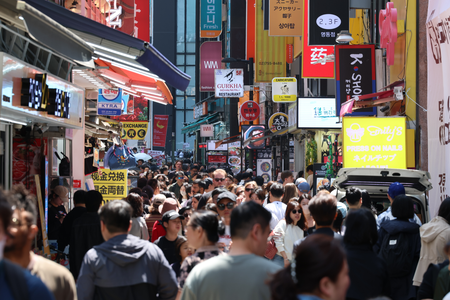
Seoul, June 24 (IANS) The number of South Koreans relocating to new regions fell 1.5 per cent in May from a year earlier to the lowest level in 52 years, data showed Wednesday, amid a recent decline in housing supply.
Around 466,000 people changed residences in May, down 7,000 from a year earlier, according to data from South Korea’s Ministry of Data and Statistics. It marked the lowest figure for any May month since 415,000 tallied in 1974.
The population mobility rate — which refers to the number of people relocating per 100 residents — fell 0.2 percentage point from a year earlier to 10.8 per cent, reports Yonhap news agency.
The ministry attributed the decline to a decrease in the number of new homes on the market.
The number of completed housing units in March and April fell 41.5 per cent from a year earlier, although the number of homes traded during the period rose 6.8 per cent.
By region, Seoul posted a net outflow of 4,221 residents, while Gyeonggi Province, which surrounds the capital, recorded a net inflow of 2,433 residents.
South Chungcheong Province and Incheon, west of Seoul, added 1,284 and 1,237 residents, respectively.
Meanwhile, the number of babies born in South Korea shot up 18 per cent in April from a year earlier, reaching the highest level in seven years, the government data also showed.
The data from the Ministry of Data and Statistics showed that a total of 24,521 babies were born in April, up from 20,787 a year earlier. It marked the highest figure for any April since 26,104 babies were recorded in 2019.
Over the January-April period, the total number of births came to 99,534, also the highest in seven years, up a sharp 15.5 per cent from a year earlier.
The number of births grew at a record rate for both April and the January-April period.
The country’s total fertility rate, the average number of children a woman is expected to have in her lifetime, rose by 0.13 from a year earlier to 0.93 in April, reports Yonhap news agency.
The number of newborns has been on an upward trend since July 2024.
–IANS
sd/