New Delhi, July 2 (IANS) When Japanese Prime Minister Sanae Takaichi arrived in India, the visit was hailed as another milestone in the Indo-Japanese partnership.
Yet, for Prime Minister Narendra Modi, this relationship is not merely a matter of statecraft — it is a personal journey that began long before he assumed office in 2014.
His fascination with Japan, its culture, and its technological brilliance stretches back decades, weaving a story of friendship, curiosity, and vision.
Prime Minister Modi’s earliest brush with Japan dates to the early 1980s, when as a young Rashtriya Swayamsevak Sangh (RSS) pracharak he befriended a Japanese visitor from Nagoya during a trip to Nepal.
As shared on Modi Story’s X account, the bond blossomed into a pen-pal friendship, with letters and gifts exchanged across borders — Japanese shoes and T-shirts from one side, and a copy of the Bhagavad Gita from the other.
Even then, Prime Minister Modi viewed such ties as more than personal gestures; they were cultural bridges.
By 2007, as Chief Minister of Gujarat, PM Modi’s engagement with Japan had matured into a mission of learning.
Leading a 40-member delegation, the Prime Minister toured Tokyo, Osaka, Hiroshima, and Kobe, meeting corporate giants like Mitsubishi, Suzuki, Toshiba, and Nippon Steel.
Agreements with Japan External Trade Organisation (JETRO) marked the beginning of Gujarat’s deep economic ties with Japan.
His meeting with the former Japan Prime Minister late Shinzo Abe during this visit sowed the seeds of a friendship that would later blossom into one of the closest relationships between two world leaders.
Prime Minister Modi’s regular inquiries about Abe’s health during his illness reflected the personal warmth behind the diplomacy.
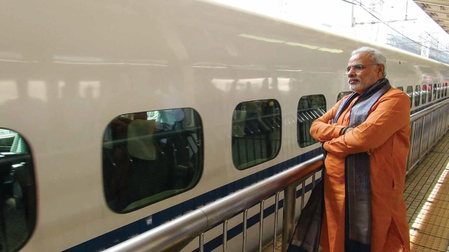
The Shinkansen bullet train ride became a turning point.
Sitting in the driver’s cockpit, PM Modi interacted with engineers about earthquake safety and punctuality systems, envisioning India’s own high-speed rail future. His curiosity extended to temples, universities, and even conversations with Japanese children, underscoring his belief that diplomacy was as much about people as it was about policy. His metaphor at a Japanese university— “Darkness cannot be defeated with a sword; a small lamp can remove it” — captured his vision of India and Japan as democratic lights in Asia.
Prime Minister Modi’s admiration translated into practical lessons.
Post-Kutch earthquake reconstruction drew inspiration from Kobe’s resilience.
Gujarat’s mid-day meal schemes borrowed from Japanese models. Diaspora engagement during Gujarat’s Golden Jubilee saw soil and water from Japan contribute to Mahatma Mandir’s construction, symbolising shared heritage.
His 2012 visit, during the 60th anniversary of India-Japan diplomatic ties, elevated Prime Minister Modi’s stature.
Honoured by the Japanese government, PM Modi attended more than 40 programmes in five days, earning praise from Japanese media as a business-friendly leader.
Despite fasting during Navratri, he tirelessly engaged investors, toured Suzuki’s plant, and articulated a vision at JETRO: “Japan has the strength of experience, Gujarat has the power of enterprise. Japan has technology, Gujarat has the talent to absorb it.”
His remark at Kobe Port— “One day, I will build Dholera like this” — foreshadowed the development of Dholera Special Investment Region.
As the Prime Minister, these experiences crystallised into strategic projects: the Mumbai-Ahmedabad High Speed Rail, the Delhi-Mumbai Industrial Corridor, and deeper defence and technology cooperation.
What began as a youthful friendship and a fascination with Japanese culture has matured into one of India’s strongest global partnerships.
The arrival of Prime Minister Sanae Takaichi is thus not just another diplomatic event — it is the continuation of a story PM Modi began decades ago, a story where personal bonds, cultural curiosity, and visionary leadership converge to shape the future of India-Japan relationship.
When Japanese Prime Minister Takaichi arrives in India, the visit will be hailed as another milestone in the Indo-Japanese partnership.
–IANS
sktr/khz