
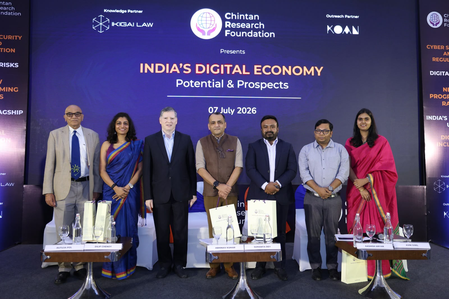
New Delhi, July 8 (IANS) India’s digital economy has emerged as a cornerstone of the country’s future economic and social advancement, experts said at a conclave on digital payments held here.
The Digital Payments conclave — organised by the Chintan Research Foundation (CRF) in partnership with Ikigai Law and Koan Advisory Group — brought together policymakers, regulators, industry leaders, legal experts, technologists and researchers to deliberate on the future of India’s digital payments ecosystem and the policy framework needed to support its growth.
They also noted that sustaining its growth will require balancing innovation with trust, resilience and consumer protection.
In his inaugural address, Sanjeev Ahluwalia, Distinguished Fellow at CRF, described the digital economy as a key pillar of India’s future economic and social progress, highlighting the transformative role played by Digital Public Infrastructure (DPI) and digital payments in expanding financial inclusion and improving economic efficiency.
Speaking at the event, Deepak Mishra, Distinguished Visiting Professor at the Indian Council for Research on International Economic Relations (ICRIER), said digitalisation cannot simply be imported but must be built on strong foundations of human capital, institutional trust and sustained investment.
He added that today’s users of artificial intelligence (AI) would become tomorrow’s innovators, stressing the need for informed engagement with emerging technologies.
Rajat Kathuria, Dean of the School of Humanities and Social Sciences at Shiv Nadar University, said India’s digital public infrastructure is built on trust and has the potential to drive productivity gains through research, data infrastructure and high-value digital services.
However, he cautioned against digital determinism, saying technological progress should remain inclusive without compromising identity protection, consent and accessibility.
Moreover, the discussions focused on the next phase of India’s digital payments journey.
Balakrishnan Mahadevan, former Chief Operating Officer of the National Payments Corporation of India (NPCI), said that while the first decade of the Unified Payments Interface (UPI) was defined by interoperability and scale, the next phase should prioritise resilience, redundancy and AI-enabled fraud detection.
Former Finance Secretary Ashok Lavasa emphasised the need for integrated infrastructure, harmonised standards and clear legal frameworks to support the internationalisation of India’s payment systems and facilitate secure cross-border transactions.
On digital assets, Megha Sidhu, Officer on Special Duty (Joint Commissioner) at the Financial Action Task Force (FATF) Cell under the Department of Revenue, said India’s approach to cryptocurrencies and virtual digital assets remains based on technological neutrality and risk-based regulation.
Additionally, experts highlighted the rising threat of digital fraud and cybercrime, calling for stronger institutional coordination, greater consumer awareness and a shift towards proactive cybersecurity measures to protect confidence in the country’s rapidly expanding digital financial ecosystem.
They said the insights from the conclave would contribute to the evolving policy discourse on building a secure, inclusive and globally competitive digital payments ecosystem in line with the vision of Viksit Bharat 2047.
–IANS
ag/