Tel Aviv, July 13 (IANS) The emergence of Pakistan as a mediator between Libya’s rival eastern and western power centres adds a “cynical” dimension to the country’s already fractured political landscape. With the explicit knowledge of Washington and several regional stakeholders, Islamabad has positioned itself in 2026 as a self-styled peace broker seeking to bridge the divide between the Libyan National Army in the east and the Government of National Unity in the west, a report has stated.
Yet this diplomatic initiative stems neither from a genuine commitment to North African stability nor from any longstanding strategic interest in the region. Rather, it reflects a transactional arrangement crafted by an economically distressed Pakistan seeking to leverage its defence infrastructure in exchange for much-needed hard currency, Amine Ayoub, a policy analyst and writer based in Morocco, wrote in The Times of Israel.
He argued that the mediation’s underlying hypocrisy stems from a $4 billion weapons agreement signed between the Pakistan Army and Saddam Haftar, Deputy Commander of the Libyan National Army (LNA) in Libya’s Benghazi in December 2025.
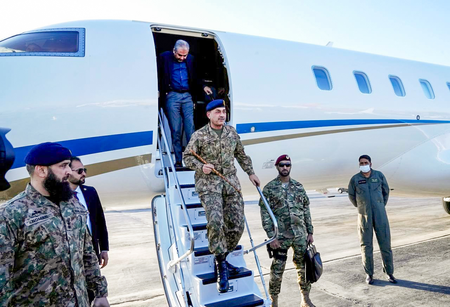
“In a blunt display of realpolitik, Pakistan’s Army Chief Asim Munir met with Saddam Haftar to seal one of Islamabad’s largest-ever military exports, an order encompassing sixteen JF-17 fighter jets, basic trainers, and long-term technical training. That this massive transaction moved forward in blatant defiance of the long-standing United Nations arms embargo highlights the hollow nature of international law when cash and weapons change hands. For Pakistan to now claim the mantle of an objective, neutral arbiter is structurally absurd,” said Ayoub.
“A state cannot act as a primary arms supplier to one faction in a civil war while simultaneously presenting itself to the other side as an unbiased peace broker. This double game has predictably triggered profound skepticism and open hostility across western Libya, where political and military factions in Tripoli and Misrata correctly perceive Islamabad as deeply compromised by its financial and military alliances with the Haftar family. The rhetoric of neutrality quickly dissolves when confronted with the physical reality of Pakistani-supplied hardware reinforcing the eastern military apparatus,” he added.
According to the report, for the United States, involving Pakistan in the process is a calculated strategy aimed at managing risks while maintaining plausible deniability. Rather than committing its own personnel or political capital to the difficult task of militia disarmament and institutional integration, it said, Washington has shifted these security tasks to a Pakistani military establishment that is “eager to please and desperate for revenue.”
“Pakistan is essentially acting as a low-cost security subcontractor, brought in to handle the volatile field logistics of collecting weapons and policing rival militias while the primary Western architects remain safely insulated from direct exposure if the deal unravels. This arrangement relies on the illusion that external enforcement can substitute for domestic legitimacy. In reality, it guarantees that Libya’s stabilisation remains a distant mirage, sacrificed to satisfy the financial necessities of a broken South Asian economy and the geopolitical convenience of a detached American foreign policy,” the report noted.
–IANS
scor/as