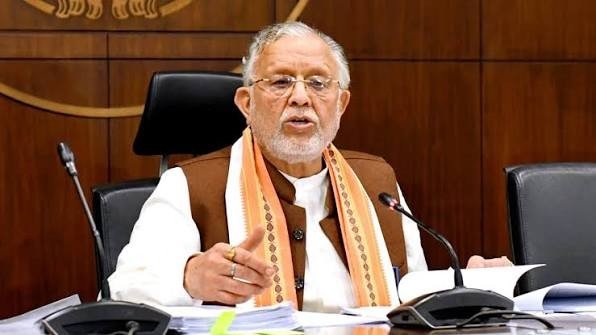
UP Finance and Parliamentary Affairs Minister Suresh Kumar Khanna said that, thanks to the Yogi government’s efforts, awareness of insurance has increased among urban and economically capable sections. However, there is still a strong need to expand its reach to rural areas and weaker sections. “During illness, accidents or any other adverse situation, economically weaker families face the greatest financial crisis. In such circumstances, insurance can become an important means of providing them financial security and reducing losses,” he remarked.
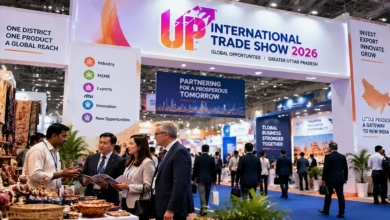
Finance Minister was speaking as Chief Guest at the ‘Financial Inclusion: Insurance is Essential’ program organized at the UP International Trade Show. Experts from the insurance sector shared information on various aspects of health insurance, motor insurance, claims, government insurance schemes, and financial inclusion at the program.
Finance Minister noted that several schemes are being implemented at both the central and state levels and people are also aware of them. “Despite this, the greater the publicity and outreach of these schemes, the more people will benefit. It is particularly important to take information about insurance to rural and economically weaker sections,” he stated.
He pointed out that capable and urban sections have relatively greater awareness of insurance, but rural areas still need increased awareness. “In the event of an accident or any other adverse situation, a major financial burden can fall on an economically weaker family. Through insurance, this loss can be reduced to a considerable extent,” he observed.
Suresh Khanna also underlined the important role of insurance agents and companies. “Agents should not limit themselves to getting policies issued. They should provide policyholders with complete information about premiums, renewals, claims and other necessary terms and conditions. This will ensure that people do not face difficulties in making claims when the need arises,” he stated.
He added that insurance information should also reach public representatives in rural areas and people who are directly connected with communities at the local level. “Through them, more people can be made aware in villages,” he remarked.
Citing the example of third-party insurance for vehicles, the Finance Minister said its importance is often understood only after an accident occurs. “In villages, people often fail to take the necessary insurance for vehicles due to negligence or lack of information. If an accident occurs and a third person suffers a loss, it can become a major financial problem,” he pointed out. He emphasized that third-party insurance is important for covering such risks. “Therefore, there is a need to create awareness among vehicle owners about it,” he added.
The workshop also provided detailed information on health insurance. Experts explained that under certain circumstances, as per the policy’s terms and conditions, a reimbursement claim can also be made for treatment taken outside a network or empaneled hospital, provided the necessary documents and formalities are completed.
The Finance Minister said this information needs to reach the general public. “Many times, policyholders do not have complete information about the facilities available under their policy and the claim process. As a result, they are unable to avail the full benefit of insurance when the need arises,” he observed.
Referring to the Pradhan Mantri Jan Arogya Yojana at the program, Finance Minister stated that earlier, when a person in a family suffered from illnesses such as liver cirrhosis, serious kidney disease, cancer or heart disease, meeting the cost of treatment became a major challenge. “The savings of many families would get exhausted and they would even reach a situation where they had to sell or mortgage their land and property,” he remarked.
He noted that Pradhan Mantri Jan Arogya Yojana has provided major relief to economically weaker families. “Under the scheme, eligible families receive health cover of up to Rs. 5 lakh per family per year for hospitalization and treatment at secondary and tertiary-level hospitals,” he stated.
The program also said the scheme provides cashless treatment at government and empaneled private hospitals. It also provides portability across the country. This means that an eligible beneficiary can also undergo treatment at a hospital covered under the scheme in another state. In Uttar Pradesh, both the Central and State Governments contribute to the scheme’s financing. Central Government has a 60% share, while the Uttar Pradesh Government has a 40% share.
Finance Minister said the objective of discussing financial inclusion and insurance on a platform such as the UP International Trade Show is not merely to provide information about schemes, but also to take insurance to as many people as possible. “For this, insurance companies, agents and local representatives will have to work together,” he said.
He emphasized that special attention should be given to people who are below the poverty line, economically weaker, or for whom the cost of an accident or serious illness could disrupt the financial condition of the entire family.
Secretary, Finance, Government of Uttar Pradesh Sandeep Kaur; IRDAI GM Pankaj Tiwari; Axis Max VP Sumit Satyan; Bajaj General Insurance VP Ejaz Khan; and Care Health Rural CDO Atul Sabarwal, along with officials and experts from the insurance and financial sectors, were present at the program.
Finance Minister speaks at ‘Financial Inclusion: Insurance is Essential’ program at UPITS
“Awareness about insurance has increased due to the efforts of Yogi government; insurance provides major protection in reducing financial losses during accidents and illnesses”
Appeal to insurance agents: Provide people with complete information about policy terms and the claim process