
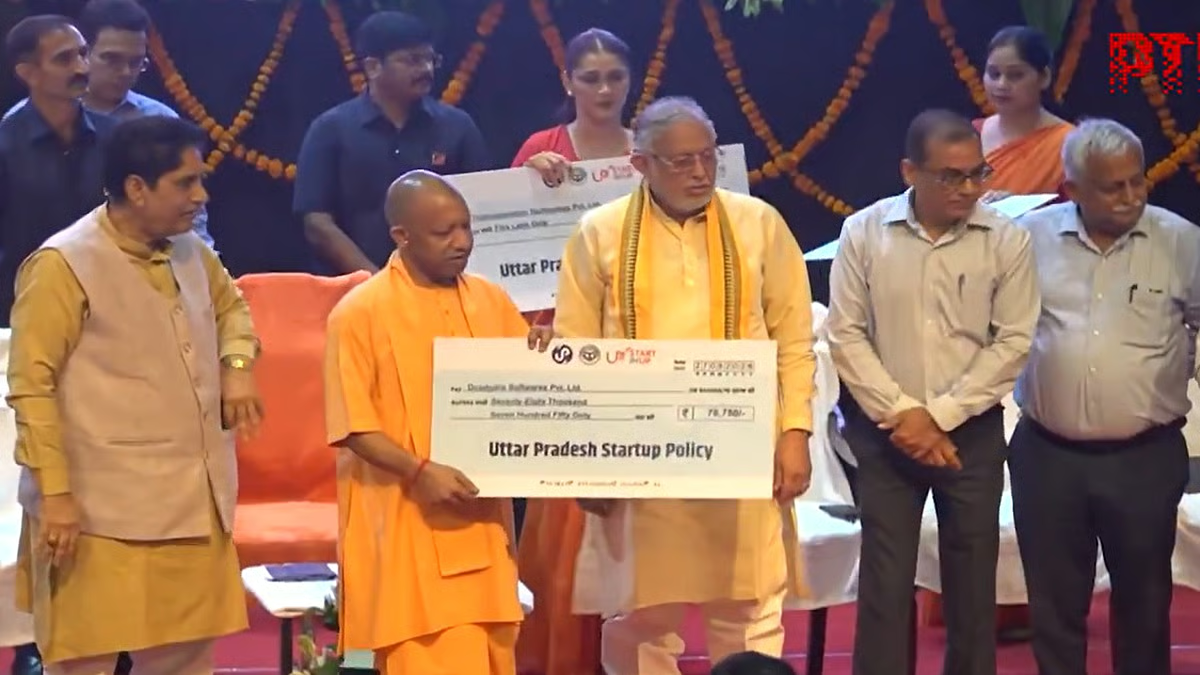
The Yogi government has implemented the Startup Policy-2026 to make Uttar Pradesh a startup hub. The policy focuses on promoting innovation, technology and entrepreneurship. Its objective is to build a robust startup ecosystem in the state, where young people can access opportunities to turn their ideas into businesses, secure financial assistance, receive expert guidance and take their products to market.
To achieve this, infrastructure development, financial assistance, talent development, industry linkages, ecosystem promotion and institutional support have been identified as the policy’s six key pillars. By focusing on emerging technologies such as Artificial Intelligence (AI), quantum computing and deep-tech, the state is paving the way for the growth of innovation-driven enterprises.
Sumit Mahajan, CEO of the UP Startup Mission, said, “The Yogi government is working to encourage young people in the state to emerge not only as job seekers but also as entrepreneurs who generate employment.”
Through Startup Policy-2026, Chief Minister Yogi Adityanath aims to ensure that young people, students, researchers and aspiring entrepreneurs have access to the necessary resources, guidance, technological facilities and market linkages to develop their ideas under a single system. This is expected to encourage new enterprises tailored to local needs across different regions of the state.
The Uttar Pradesh Startup Policy-2026 has been formulated around six key pillars: infrastructure development, financial assistance, talent development and capacity building, industry linkages, ecosystem promotion and outreach, and strengthening and enabling the ecosystem.
The CEO said, “The first pillar focuses on improving physical and digital infrastructure for startups. The second pillar aims to expand opportunities for accessing capital through government schemes and private investors. Under the third pillar, talent development and capacity building, the objective is to create an innovation-driven workforce through education, skill development and training. The fourth pillar seeks to promote collaboration among startups, industries, academic institutions and the government, helping new enterprises gain access to markets. The fifth pillar focuses on promoting the state’s startup potential at the national and international levels, developing partnerships and undertaking targeted promotional activities. The sixth pillar places emphasis on strengthening institutional capacity, stakeholder participation and mechanisms for collaboration.”
Under the new startup policy, the StartinUP online portal will be developed as an integrated digital platform. It will bring startups, investors, incubators, mentors, Centres of Excellence (CoEs) and other stakeholders together on a common platform. It will be developed as the digital identity of the Yogi government’s startup programme, promoting transparency and better management of activities in policy implementation.
Information on startup policies, incentives, resources, incubation centres, upcoming events and government schemes will be made available on the portal. Entrepreneurs will also be able to access capacity-building programmes and courses covering areas such as entrepreneurship development, startup management, financial literacy, regulatory compliance, intellectual property rights (IPR), technology commercialisation and market access.
Subject experts and partner institutions will be onboarded to support these initiatives. Startups, incubators and Centres of Excellence will be able to register online through the platform. They will also be able to apply for incentives and submit their claims to the concerned nodal agency.
The nodal agency will oversee the evaluation and approval of applications and claims. The portal will also feature a Management Information System (MIS) to monitor daily activities and track policy implementation. In addition, arrangements will be made to integrate the portal with the Central Government’s Startup India platforms, including DPIIT, BHASKAR and MAARG. The system has also been designed to accommodate new features and potential integration with other portals in the future.
A toll-free helpline and social media-based support will be available to address startup-related grievances and queries.
The platform will promote networking, partnerships and collaboration among startups, incubators, accelerators, mentors, investors and Centres of Excellence.
Focus on AI, quantum computing and deep-tech, with emphasis on funding, skill development, industry linkages and global recognition
StartinUP online portal to serve as a single-window platform, with the entire process from registration to incentives going online
Toll-free helpline and social media support to help resolve startup-related issues
New startup policy to turn young people’s ideas into businesses, bringing startups, investors and incubators onto a common platform