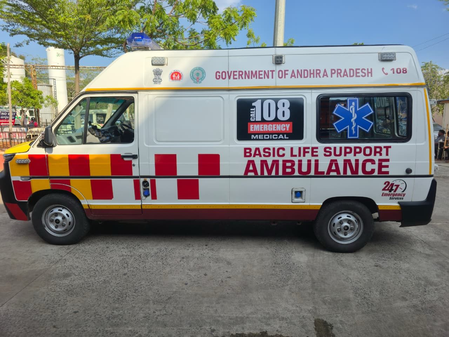
Vijayawada, June 7 (IANS) The Andhra Pradesh government has overhauled the 108 ambulance emergency services, turning it into an ultra-efficient lifeline for millions.
Operating under the core philosophy that “every second counts when saving a life,” the state’s emergency network has been modernised to meet international trauma care standards, said an official release on Sunday.
Partnering with Bhavya Health Care, the coalition government has integrated advanced GPS tracking, real-time traffic routing, and digitised patient logs into the ambulances. This ensures that victims are reached and stabilised within the critical medical window known as the “Golden Hour.”
From June 2025 to May 2026, this rejuvenated framework successfully responded to 7,78,799 emergency calls, acting as a beacon of hope for families across both rural and urban Andhra Pradesh, it said.
During this year-long operational cycle, 108 emergency response teams stabilized 1,13,764 road accident victims right at the site of trauma. Furthermore, the service solidified its role as a cornerstone of rural healthcare by safely transporting 1,05,786 pregnant women to advanced maternal care facilities, significantly contributing to the drop in maternal and infant mortality rates.
The operational efficiency of the fleet is split into two critical streams of medical logistics: Inter-Facility Transfers (IFT) and non-IFT emergencies.
Under IFT, 2,53,022 cases were handled, seamlessly transferring critical patients from primary healthcare centres to tertiary super-speciality hospitals without breaking the continuum of care.
Non-IFT emergencies covered 5,25,777 cases. These were direct, high-speed dispatches to accidental sites, homes, and remote fields, providing on-the-spot triage and immediate evacuation to the nearest medical centre.
State-wide emergency services responded to a staggering 7,78,799 total cases, providing critical, tactical medical interventions across a diverse range of medical crises.
Road traffic accidents topped the list with 1,13,764 cases requiring rapid trauma stabilisation, closely followed by 1,05,786 pregnancy and maternity emergencies that required safe delivery monitoring and prenatal transport.
First responders managed a massive 97,118 cases of respiratory distress, deploying immediate oxygen administration and advanced airway management.
According to the official statement, crews successfully stabilised 49,342 non-vehicular injuries using haemorrhage control, while also managing 45,951 cardiac emergencies and 40,553 cases of unconsciousness through advanced tracking and resuscitation protocols.
The remaining volume included thousands of time-critical interventions, including 34,532 abdominal pain assessments, 32,858 poisoning cases, 29,485 seizure episodes, 20,278 acute strokes, and 14,007 neonatal (newborn) emergencies requiring advanced paediatric life support.
In conditions like acute myocardial infarction (heart attacks), a delay of even five minutes can mean the difference between permanent cardiac muscle damage and survival. The 108 Emergency network has specialised its response protocols for the 45,951 heart-related cases managed this year.
Ambulances are equipped with advanced life support systems (ALS), automated external defibrillators (AEDs), and specialised communication setups. Highly trained Emergency Medical Technicians (EMTs) can transmit vital patient data directly to receiving hospital ERs while in transit. The quick presence of mind, intensive training, and deep empathy of these EMTs ensure that patients are stabilised, reassured, and kept alive before they ever reach the hospital doors.
–IANS
ms/uk