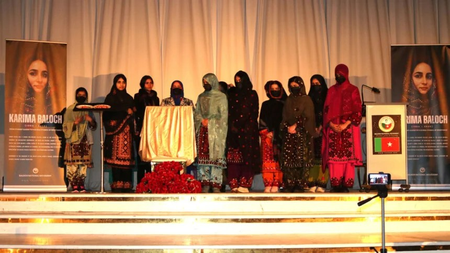
London, Dec 22 (IANS) The Baloch National Movement (BNM) held a seminar in London to mark the fifth death anniversary of human rights activist Banuk Karima Baloch, highlighting systematic oppression by Pakistani authorities in Balochistan.
The event brought together political leaders, intellectuals, human rights activists, and representatives of Sindhi, Pashtun, and other communities from Pakistan-occupied Kashmir and Pakistan-occupied Gilgit-Baltistan, who expressed solidarity with the struggle of the people in Balochistan.
The speakers at the event included BNM Chairman Naseem Baloch; author Naseer Dashti; University of London scholar and SOAS South Asia Centre member Burzine Waghmar; World Sindhi Congress (UK & Europe) Deputy Organiser Fahmeeda Khushik; human rights activist Noor-e-Maryam Kanwar; Pashtun Tahafuz Movement (PTM) representative Brakhna Sayyad; and Banuk Karima’s cousin, Mehlab Kambar.
Addressing the gathering, the BNP Chairman Naseem Baloch, emphasised that Karima’s “life and martyrdom” exposed the “colonial nature” of the Pakistani state and its systematic repression of “oppressed nations”.
He criticised Western governments for the “selective application of human rights principles”, questioning why occupation and oppression are condemned in some regions but ignored in Balochistan and other oppressed areas.
Naseem stated that Karima challenged not only Pakistani military occupation but also the “occupation of history, language, resources, and political authority”.
Concluding, he said that “freedom is not extremism but a natural human instinct, and peace in the region is impossible until Pakistan’s colonial structure is dismantled and oppressed nations attain freedom.”
Meanwhile, Burzine Waghmar strongly criticised Pakistan’s human rights record and held the country’s deep state responsible for the killing of Karima Baloch. He said, “Pakistan exploits international neglect and impunity to target peaceful activists even in exile”.
Human rights activist Noor-e-Maryam Kanwar said that collective punishment is among the most brutal methods used against the people of Balochistan.
She cited the enforced disappearance of the father of prominent Baloch human rights activist, Mahzeb Shafiq, explaining how Pakistani authorities target families to suppress resistance.
Pashtun Tahafuz Movement representative Barkhna Syed expressed solidarity with the Baloch struggle, noting that enforced disappearances and collective punishment have become a daily reality in Pashtun regions as well.
Recalling Karima’s fight against Pakistani authorities, her cousin Mehlab Kambar highlighted her continuous struggle for justice, national identity, and collective strength.
She said Karima organised rallies and protests for enforced disappeared persons and consistently raised her voice against the genocide in Balochistan.
–IANS
scor/sd/