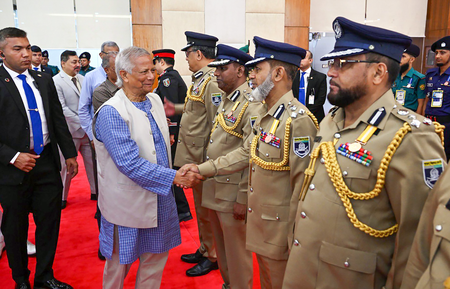
Dhaka, Jan 29 (IANS) Under Bangladesh’s interim government led by Muhammad Yunus — globally recognised for pioneering microfinance for advancing women’s empowerment — the political representation of women in the country has not been institutionally safeguarded, a report said on Thursday.
It added that, notwithstanding its reformist mandate, the interim government has not intervened decisively to safeguard or expand women’s presence in political decision-making, and this inaction risks pushing women’s political participation further back, at a time when party structures are actively restricting access.
According to a report in Bangladesh’s leading newspaper, The Daily Star, following last week’s nomination withdrawal deadline for the country’s February 12 election, except for two constituencies, women accounted for just over four per cent of candidates contesting general seats, with 30 registered political parties fielding no female candidates at all.
“This is not a pipeline problem, but a structural divergence: women are increasingly present in governance and service delivery, but systematically excluded from competitive political power. This divergence tells us something important: that in Bangladesh, women have been professionalised for growth, but not politicised for governance,” it stated.
Citing a report of Bangladeshi leading daily Prothom Alo, it stated that despite the Bangladesh National Consensus Commission proposal requiring individual political parties to nominate women candidates in five per cent of general seats, most political parties failed to comply. While the Bangladesh Nationalist Party (BNP) nominated only 3.5 per cent women candidates, and Jamaat-e-Islami nominated none.
“Smaller parties initially nominated a few women but withdrew some of them afterwards. Former women’s affairs reform commissioners and women’s rights activists criticised the parties for failing to honour promises and limiting women’s political participation. This highlights a broader trend of women being underrepresented in Bangladeshi elections despite prior agreements and advocacy efforts,” it mentioned.
Women’s exclusion from electoral politics, the report said, is often justified in terms of culture, conservatism, or lack of “electability”, yet the current pattern reflects a political backlash.
“As women’s social and economic agency expanded through education, income, public authority and visibility, their potential political presence became harder to ignore. Rather than absorbing this shift, party structures responded by retrenching. Women are being redirected to reserved seats. Competitive constituencies are deemed “too risky.” This backlash is as ideological as it is procedural and strategic,” it noted.
Highlighting that the digital sphere in Bangladesh continues to reinforce this exclusion, the report further said, “Women who speak politically face disproportionate online harassment, moral policing, and character attacks. Parties interpret this hostility as electoral liability, using it to justify their reluctance to nominate women. The result is a self-reinforcing cycle: women are excluded because politics is hostile, and politics remains hostile because women are excluded.”
–IANS
scor/as