New Delhi, Dec 7 (IANS) The political battle over the legacy of B.R. Ambedkar, the architect of India’s Constitution and a towering Dalit leader, has intensified in recent months. At the heart of this contest lies a clash between the Congress party’s attempt to preserve the aura of Jawaharlal Nehru and the Bharatiya Janata Party’s (BJP) effort to expose Congress’ historical neglect and even hostility towards Ambedkar.
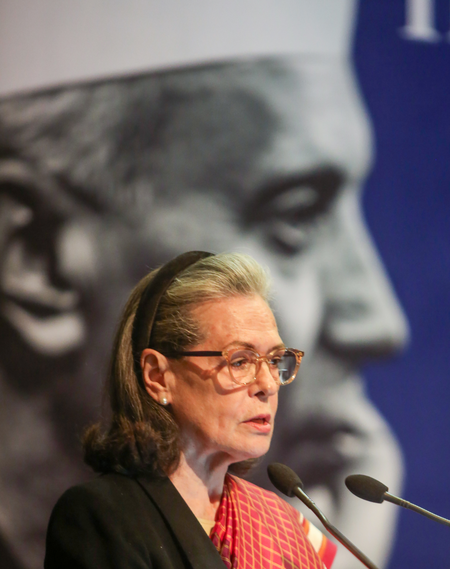
What emerges is not merely a debate over history but a struggle for political ownership of Ambedkar’s legacy. Sonia Gandhi’s recent remarks at the launch of The Nehru Centre India encapsulate Congress’ defensive posture. In a lengthy post, she lamented what she described as “systematic attempts” to denigrate Nehru, accusing the ruling establishment of trying to erase his contributions and destroy the foundations of the nation.
She argued that Nehru’s life and work must be understood in historical context and warned against deliberate distortions of his legacy. Her words were clearly aimed at the BJP, which has often critiqued Nehru’s policies on Kashmir, China, and economic planning. Yet, while Congress passionately defends Nehru, its record on Ambedkar tells a different story.
The BJP has seized upon this contradiction, pointing to instances where Ambedkar was sidelined, undermined, or even insulted during Congress-led governments.
Union Minister Dharmendra Pradhan last year revived a particularly damning example: the NCERT Class 11 textbook published during UPA-2 in 2012, which carried a cartoon depicting Nehru whipping Ambedkar. The cartoon sparked outrage, with BJP leaders condemning it as a deliberate insult to Ambedkar’s dignity. Kapil Sibal, then Human Resource Development Minister, was forced to apologise in Parliament, acknowledging the offensive nature of the depiction and ordering its withdrawal.
The controversy did not end there. Amit Malviya, the BJP’s in-charge of BJP’s National Information and Technology Department, had posed a question on his X handle on December 19, 2024, “Kapil Sibal, amidst protest from the BJP, announced its withdrawal in the Parliament, stating that NCERT books are developed by a committee. He specifically identified Yogendra Yadav as the “Chief Advisor” to the committee. It is the same Yogendra Yadav, who was part of Sonia Gandhi’s NAC, member of Rahul Gandhi’s Bharat Jodo Yatra, even actively campaigned for the Congress in Haryana and delivered the infamous ‘आंधी सुनामी’ speech in Rahul Gandhi’s presence. Why is the Congress nurturing Ambedkar and Dalit hating people like Yogendra Yadav in their ranks? Or, are they brought in to serve Congress’s agenda of marginalising Dalits?” Malviya had asked.
The chief advisor to the NCERT committee responsible for the textbook was Yogendra Yadav, a figure closely associated with Congress circles, Sonia Gandhi’s National Advisory Council, and Rahul Gandhi’s political campaigns, he had said.
The BJP has rightly questioned why Congress continues to nurture individuals who have displayed insensitivity towards Ambedkar and Dalit concerns. Was this merely an oversight, or part of a deeper pattern of marginalisation? This episode is emblematic of Congress’ selective memory. While it lionises Nehru to preserve its dynastic narrative, it has historically marginalised Ambedkar, whose vision of social justice and constitutional democracy resonates deeply with Dalits and the wider Indian polity.
Ambedkar’s disagreements with Nehru and the Congress leadership are well documented — from his resignation as Law Minister over the Hindu Code Bill to his criticism of Congress’ failure to address caste oppression meaningfully. For decades, Ambedkar was celebrated more by grassroots Dalit movements than by the Congress establishment, which preferred to keep the spotlight firmly on Nehru and the Gandhi family.
The BJP has positioned itself as the custodian of Ambedkar’s legacy, celebrating his contributions through memorials, scholarships, and public commemorations. Prime Minister Narendra Modi has repeatedly invoked Ambedkar’s vision of equality and dignity, framing it as central to the BJP’s social empowerment agenda.
By highlighting Congress’ past insults and neglect, the BJP seeks to contrast its own embrace of Ambedkar with Congress’ dynastic obsession.
The tug of war over Ambedkar is not merely symbolic — it reflects deeper ideological battles. Congress’ narrative is rooted in Nehruvian elitism, emphasising secularism and centralised planning, while often glossing over caste realities. The BJP, by contrast, has sought to integrate Ambedkar’s vision into its broader narrative of social justice, national unity, and empowerment of marginalised communities. This ideological divergence explains why Sonia Gandhi’s defence of Nehru rings hollow to many Dalits, who recall Congress’ history of sidelining Ambedkar.
Moreover, the BJP’s critique gains traction because it resonates with lived experiences. Dalits have long felt excluded from Congress’ upper caste dominated leadership structures, while Ambedkar himself was often treated as an outsider within the Congress fold. The cartoon controversy is not an isolated incident but part of a larger pattern of disregard.
By reminding the Congress party of its past actions, the BJP strengthens its claim to Ambedkar’s legacy and positions itself as the party that truly honours his vision.
The stakes are high. Ambedkar’s legacy is not just about history — it is about contemporary politics, identity, and empowerment. For Dalits and marginalised communities, Ambedkar represents dignity, equality, and resistance against oppression. Whoever claims his legacy gains moral authority and political capital.
Congress’ attempt to defend Nehru while glossing over its treatment of Ambedkar exposes its contradictions. The BJP, by foregrounding Ambedkar and exposing Congress’ record, seeks to reshape the narrative and align itself with the aspirations of Dalits.
In the end, the tug of war over Ambedkar is a battle for India’s soul. Congress clings to Nehru to preserve its dynastic legitimacy, but its neglect of Ambedkar undermines its moral authority. The BJP, by embracing Ambedkar and critiquing Congress’ record, positions itself as the true custodian of his vision. For Dalits and marginalised communities, the choice is stark: between a party that once printed cartoons mocking their leader, and a party that seeks to honour him as the cornerstone of India’s democratic journey.
–IANS
sktr/dpb