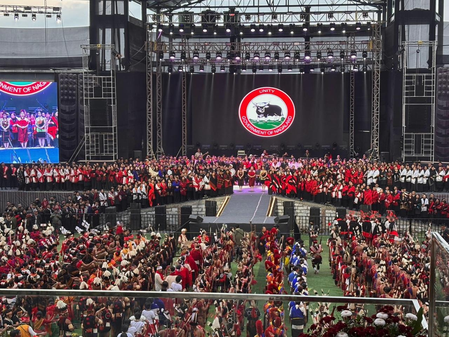
Kohima, Dec 7 (IANS) The seventh day of the 26th edition of the Hornbill Festival on Sunday featured a vibrant display of traditional performances by cultural troupes from all eight Northeastern states at the Naga Heritage Village in Kisama, near Kohima.
The cultural performances embodied the rich cultural diversity and a celebration of the spirit of harmony of all the eight Northeastern states, extending from the majestic hills of Nagaland and Meghalaya to the beautiful valleys of Manipur and Mizoram, from the mighty Brahmaputra of Assam to the unique heritage of Arunachal Pradesh, Tripura and Sikkim.
Day 7 of the Cultural Connect held at Unity Plaza in Naga Heritage Village, Kisama, on Sunday, was attended by Deputy Chief Minister Yanthungo Patton as the host and Kekhrielhoulie Yhome, Advisor, School Education, SCERT, as the co-host. The Day’s highlights included Mizoram’s Cheraw (Bamboo) Dance, known for its rhythmic use of bamboo staves, and Sarlamkai, a warrior dance symbolising victory.
From Arunachal Pradesh, the Nyishi community presented Juju Jaja Jaminja, performed during harvest to invoke the Deity of Wealth, along with Rikhampada, featuring devotional songs and love ballads traditionally sung by women. Manipur’s Kabui Rongmei community showcased Duisha Laam, or the Waterfall Dance, reflecting the graceful flow of water, and Kit Laam, inspired by the flamboyant movement and gaiety of crickets after the monsoon.
Tripura’s Chakma community performed the popular Bizu Dance, noted for its sudden pauses, and the Jhum Dance (performed during shifting cultivation), representing the various stages of jhum cultivation through circular and linear formations. From Meghalaya, the Khasi community performed Mastieh Dance, a thanksgiving dance to express gratitude to the Creator for good health and prosperity, and a Harvest Dance, performed by men and women joyfully after harvest.
Nagaland’s Lotha women presented Nzanta, a post-harvest thanksgiving dance, and Mungyanta, performed during the Tokhu Emong festival to celebrate the fruits of their labour. Sikkim’s Bhutia community performed the Snow Lion Dance (Singhi Chham), honouring Mt. Khangchendzonga, believed to resemble the sacred snow lion that symbolises fortune and prosperity.
And the Karbi community of Assam performed Chong Kedam, a martial dance usually performed during Chomangkan to protect the spirits of the deceased from evil forces. The cultural event was curated by North East Zone Cultural Centre, Dimapur (NEZCC).
Guided by its motto ‘Unity through Culture’, the NEZCC stands as a guardian to preserve the rich artistic heritage of the eight Northeastern states. It also acts as a conduit for cultural exchange, facilitating cultural representation of the Northeast at national and international levels.
–IANS
sc/uk