Washington, May 11 (IANS) The top defence chiefs of South Korea and the United States are set to hold talks in Washington on Monday, focusing on advancing the transfer of wartime operational control (OPCON) from Washington to Seoul and Korea’s push to acquire nuclear-powered submarines.
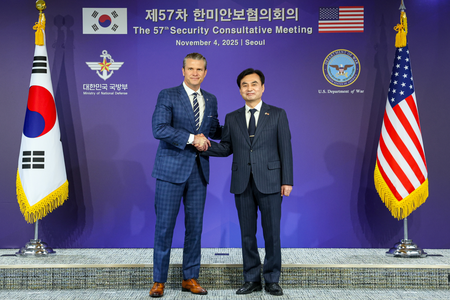
Defence Minister Ahn Gyu-back will meet US Defence Secretary Pete Hegseth to discuss follow-up steps on the OPCON transition and nuclear-powered submarines, in line with the agreements reached between the leaders and at high-level security talks last year, Seoul officials said.
The upcoming talks also come a day after South Korea determined a strike by two unidentified flying objects was behind the May 4 explosion and fire on a South Korean-operated cargo vessel in the Strait of Hormuz. The issue could be raised in Monday’s talks, reports Yonhap news agency.
South Korea is seeking to retake wartime OPCON before the Lee Jae Myung government’s five-year term ends in 2030, reportedly targeting 2028 for the transfer while US President Donald Trump is in office.
However, signs of differing views between the allies have emerged after US Forces Korea commander Gen. Xavier Brunson told Congress last month that the two sides seek to meet conditions required for the transfer no later than the first quarter of 2029.
His proposed timeline suggests the OPCON transfer may not be ready even after Trump’s term ends on January 20, 2029.
South Korea handed over operational control of its forces to the US-led UN Command during the 1950-53 Korean War. It retook peacetime OPCON in 1994, but wartime operational command still remains in the US’ hands.
Under a three-phase framework, conditions for the transfer include South Korea’s capabilities to lead combined Korea-U.S. forces, its strike and air defence capabilities, and a regional security environment conducive to such a handover.
In last year’s annual Security Consultative Meeting, Ahn and Hegseth agreed to develop a road map designed to expedite the implementation of conditions for the OPCON transfer and seek to certify the second part of the three-stage program.
The defence chiefs could also address Seoul’s findings on the ship blast, as the suspected attack has raised the possibility that South Korea could reconsider its role in efforts to ease tensions in the Middle East.
Seoul has shown reservations about Trump’s calls for naval assistance to help reopen the Strait of Hormuz. The government has said it is reviewing a US proposal for an international coalition aimed at ensuring freedom of navigation in the shipping route, dubbed the “Maritime Freedom Construct” (MFC).
On Sunday, Seoul indicated pursuing “all possible measures” to prevent a recurrence of incidents like the case of the HMM Namu cargo ship and that it is “closely” reviewing participation in the MFC.
At Monday’s talks, the two sides are also expected to discuss Seoul’s push to build nuclear-powered submarines, amid little progress since Trump gave the green light to the move during his summit talks with President Lee Jae Myung in October last year.
Before departing for Washington on Sunday, Ahn expressed confidence about making progress in talks on the strategic vessels. He did not rule out an inaugural meeting on nuclear-powered submarines taking place before the end of the first half.
–IANS
sd/