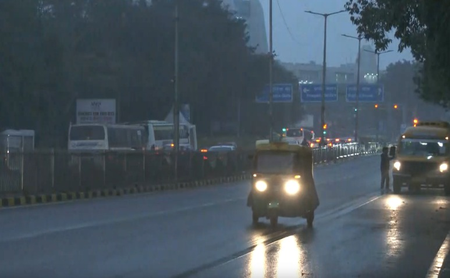
New Delhi, Jan 23 (IANS) Residents of Delhi-National Capital Region (NCR) woke up to a rainy and cloudy Friday morning as several parts of the region received moderate rainfall accompanied by thunderstorms. The change in weather is expected to bring a sharp drop in temperatures, intensifying the winter chill across the region, the weather department said.
The India Meteorological Department (IMD) has issued an orange alert for thunderstorms and rain in Delhi-NCR and parts of neighbouring Punjab and Haryana. According to the IMD, the weather activity is being driven by an active western disturbance affecting northwestern India, resulting in cloudy skies and intermittent rainfall.
The weather office has also issued a yellow alert for Delhi, forecasting one or two spells of light rain accompanied by thunderstorms, lightning and gusty winds reaching speeds of 30-40 kmph during the early morning to forenoon hours on Friday. Another spell of very light to light rain is likely later in the afternoon or evening.
The sudden change comes a day after Delhi recorded its warmest January day in seven years, with the maximum temperature reaching 27.1 degrees Celsius on Thursday. However, the IMD said a significant dip in temperatures is expected on Friday, with the maximum likely to fall to around 19 degrees Celsius, while the minimum temperature may hover near 12 degrees Celsius.
Despite the rainfall bringing some temporary relief, air quality across Delhi-NCR continues to remain a concern. Data from the Central Pollution Control Board (CPCB) and the Uttar Pradesh Pollution Control Board (UPPCB) showed marginal improvement in several areas, though pollution levels remain in the ‘very poor’ category in many locations.
Delhi’s overall Air Quality Index (AQI) was recorded at 302, placing it in the lower range of the ‘very poor’ category. Among the worst-affected areas in the national capital were Bawana with an AQI of 342, Ashok Vihar at 335, Chandni Chowk at 326, Alipur at 322, Anand Vihar at 317 and the DTU area at 312.
In the NCR, Ghaziabad recorded an AQI of 267 in Indirapuram and 290 in Sanjay Nagar, while Loni continued to witness severe pollution levels with an AQI of 390. In Noida, the AQI was reported at 249 in Sector 62, 319 in Sector 125, 290 in Sector 1 and 296 in Sector 116.
Some localities, however, saw air quality improve from the red zone to the orange zone, offering limited relief to residents. Weather experts noted that rainfall and strong winds are expected to bring down daytime temperatures significantly. As a result, even if minimum temperatures do not fall sharply, the cold conditions are likely to be felt more intensely during the day.
–IANS
jk/dpb