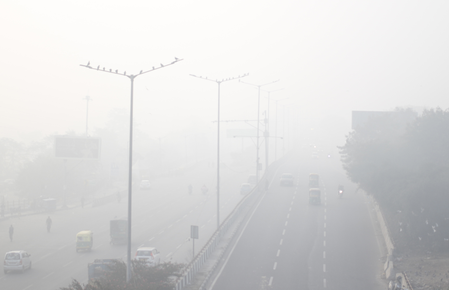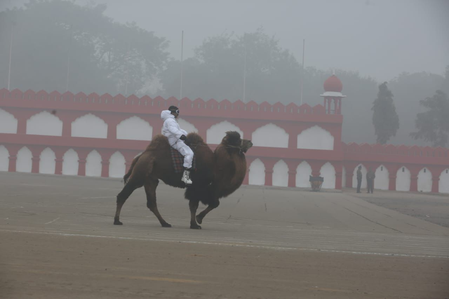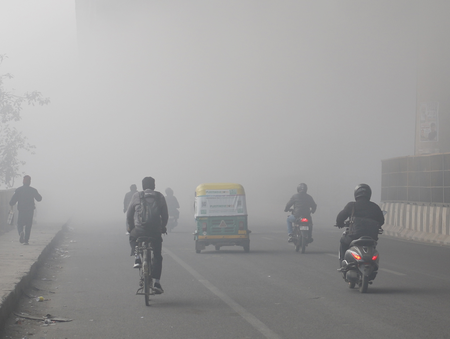
New Delhi, Jan 1 (IANS) Delhi woke up to yet another grim morning under a thick blanket of pollution and biting cold, with air quality continuing to remain in the “very poor” category as fog and low temperatures tightened their grip on the national capital on the New Year.
According to the latest data released by the Central Pollution Control Board (CPCB), the Air Quality Index (AQI) for Delhi stood at 372, reflecting sustained high pollution levels across the city.
Cold and foggy weather conditions have further worsened the situation, as reduced wind speed and low temperatures have hampered the dispersion of pollutants, allowing fine particulate matter to remain suspended in the air for prolonged periods.
Several air quality monitoring stations across Delhi reported alarming readings. Anand Vihar recorded an AQI of 418, while Wazirpur followed closely at 414.
Rohini logged an AQI of 413, with Ashok Vihar at 392.
RK Puram registered 381, ITO stood at 371, Chandni Chowk reported 377, and Siri Fort recorded an AQI of 384.
Neighbouring cities in the National Capital Region also continued to struggle with poor air quality.
Noida recorded an AQI of 364, while Ghaziabad ranked fifth with an AQI of 338. Greater Noida followed at sixth position with an AQI of 336, with all these locations falling under the very poor air quality category.
The India Meteorological Department (IMD) forecast a generally cloudy sky for Thursday and indicated the possibility of very light to light rain at isolated places.
The weather office also cautioned residents about moderate fog at many locations and dense fog at isolated places during the morning hours, along with cold day conditions in some areas.
Notably, Wednesday marked the coldest day recorded in Delhi since 2019. The maximum temperature settled at 14.2 degrees Celsius, which is 6.2 degrees below the seasonal average.
Such unusually low daytime temperatures, combined with high humidity levels and stagnant wind conditions, have significantly contributed to discomfort among residents and further deterioration in air quality across the region.
Meanwhile, a recent analysis conducted by the Centre for Research on Energy and Clean Air (CREA) revealed that Delhi remained the most polluted city in the National Capital Region in 2025, followed by Ghaziabad and Noida.
While the annual average PM2.5 concentration in Delhi showed a marginal decline compared to the previous year, the average pollution levels during the critical October to December period increased slightly compared to 2024.
The study highlighted that PM2.5 levels at all 40 monitoring stations in Delhi were at least 1.8 times, nearly double, the prescribed annual standard.
Among the 29 cities in the NCR, only 14 had PM2.5 data coverage exceeding 75 per cent in 2025, underscoring gaps in comprehensive air quality monitoring across the region.
–IANS
sd/