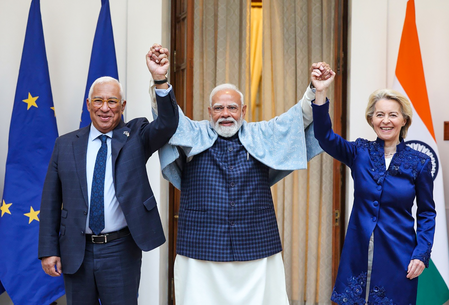
Washington, Jan 29, (IANS) The International Monetary Fund (IMF) on Thursday described the India–European Union (EU) Free Trade Agreement (FTA) as a positive development, noting that it reflects countries’ efforts to deepen economic integration amid rising global trade tensions and uncertainty.
Responding to questions during a briefing on emerging market economies, IMF Economic Counsellor and Director of Research Pierre-Olivier Gourinchas said recent trade agreements show that governments are seeking pragmatic ways to expand trade ties even after a turbulent year for global commerce.
“We have had two important agreements that were announced at different stages of development,” Gourinchas said, referring to the recently signed EU–Mercosur agreement and the EU–India FTA.
“I think both of these developments are positive,” Gourinchas said. “They’re positive for the EU, they’re positive for Mercosur countries, and they’re positive for India.”
He said the agreements demonstrate “the willingness of a number of countries to go beyond the trade tensions that we’ve witnessed in 2025” and to find ways to deepen economic integration that can benefit multiple regions.
Gourinchas pointed to the long-term record of trade integration as a driver of growth for emerging and developing economies. “When you look back at the last 50–70 years of developments in the global economy, trade integration, in particular for emerging market and developing economies, has been really a vector of development,” he said.
“It has pulled hundreds of millions of people out of poverty, has helped these countries grow rapidly and achieve much better standards of living,” he said, adding that there is “a well-established record” supporting the role of trade openness.
In the current global environment, Gourinchas said it matters that some countries are still pursuing deeper trade relations where progress is possible. “Saying that some countries are trying to find ways to deepen trade relations where they can is something that is positive,” he said.
At the same time, he cautioned against viewing trade liberalisation as cost-free. “We shouldn’t be totally naive about trade,” Gourinchas said, noting that trade integration produces both winners and losers.
“There are some winners, and there are also other parts of the economy that can be hurt by increased competition, the displacement of jobs,” he said, adding that such adjustment costs should be acknowledged and addressed through policy.
“But overall, the net gains are positive,” Gourinchas said.
He also stressed that trade agreements can bring policy certainty at a time of global volatility. “These trade deals are bringing a certain amount of policy certainty,” he said, adding that predictability allows businesses to operate in a clearer environment, make investment decisions and mobilise resources.
“They can decide where to invest,” he said, noting that such certainty can support investment flows and economic stability.
The comments came ahead of an IMF conference on emerging market economies being organised with Saudi Arabia’s Ministry of Finance in AlUla, where policymakers will discuss resilience, trade integration and managing economic transitions amid heightened global uncertainty.
–IANS
lkj/as