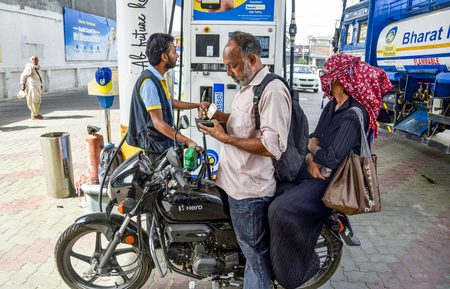
New Delhi, May 19 (IANS) The government has ensured that the price hike in petrol and diesel has been restricted to 4.4 per cent, the lowest among major economies, while that of domestic liquefied petroleum gas has remained constant, by reducing excise duty and asking the oil companies to absorb the losses due to the cost of imported crude soaring past $100 a barrel.
Public sector oil companies have absorbed under-recoveries of Rs 24,500 crore on petrol and diesel to keep pump prices on hold, before resorting to a price hike of Rs 3.91 per litre in the two fuels in two instalments, according to official sources.
The government has absorbed Rs 30,000 crore by way of loss in revenue due to the reduction of excise duty on petrol and diesel, while the oil companies have lost Rs 24,500 crore on the two fuels and another Rs 40,000 crore on holding the price of liquefied petroleum gas for domestic consumers, a senior official told IANS.
India’s oil marketing companies increased petrol and diesel prices by Rs 3.91 per litre in two hikes of Rs 3 and 91 paise respectively.
The Central excise component of the petrol and diesel price is the same in every state of the Union.
The pump price diverges due to the value-added tax each state government levies.
States with the highest pump prices include Telangana, Kerala, Karnataka, and Tamil Nadu, while the lowest are Gujarat, Uttar Pradesh, Delhi, Haryana, Goa, and Assam.
An Indian Oil official pointed out that the Rs 3.91 increase, which restores only part of the rise in crude oil costs, was implemented after 76 days of complete cost absorption by the public sector oil companies.
In sharp contrast, the rest of the world has been adjusting prices for the rise in crude oil costs through increases ranging from 10 to 90 per cent in the retail prices of the two fuels.
Myanmar, Malaysia, Pakistan, and the United Arab Emirates have all seen petrol prices rise by more than half of their pre-war prices, with diesel rising even more sharply because of its closer link to global trade and freight.
The Pakistani consumer is paying about 55 per cent more for petrol today than three months ago, the Malaysian consumer about 56 per cent more, and consumers in the United Arab Emirates about 52 per cent higher prices, the figures show.
In advanced economies, the increases are smaller in percentage terms but still substantial.
American petrol prices, which respond quickly to crude oil prices because federal and state excise loadings are modest, have risen by close to 45 per cent and diesel by 48 per cent.
In Europe, where excise duties dampen the swing, the United Kingdom is up about 19 per cent on petrol and 34 per cent on diesel, Germany is up about 14 per cent on petrol and 20 per cent on diesel, and France is up about 21 per cent and 30 per cent, respectively.
In Japan, South Korea, and Singapore, the hike in petrol prices has been kept below 20 per cent, while diesel prices have risen considerably faster, with Singapore registering a 65 per cent jump.
–IANS
sps/dan