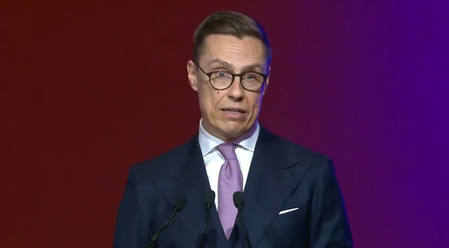
New Delhi, March 5 (IANS) Finland President Alexander Stubb on Thursday highlighted India and Global South’s growing role in shaping a cooperative, fair and representative multilateral world order. In his address at the Raisina Dialogue in New Delhi, Stubb stated that the world is changing much like how it did after the World War I, World War II and the Cold War. He noted that the era of western dominated world is over.
“My thesis is very simple. I believe that the Global South will decide what the next world order will look like and India as a major power will be a major or if not ‘the force’ in deciding whether the world will tilt towards conflictual multipolarity characterised by deals, transactions and spheres of interest or whether the world will tilt towards a new cooperative, fair and representative multilateral world order based on international institutions, rules and norms. The policy choices that India and other key powers make truly matter in this time of transition. They will set the direction of the future.”
The 11th edition of the Raisina Dialogue, India’s flagship conference on geopolitics and geo-economics, commenced in New Delhi on Thursday, bringing together an array of global leaders, policymakers and strategic experts. President Stubb is the chief guest at Raisina Dialogue.
Stubb mentioned that the power balance has shifted and the Global South has both demography and economy on its side.
“I mean here we are in a country which is portraying growth rates of 7 per cent, probably projecting all the way to 2047. And at the same time, it’s the biggest democracy in the world. But, my argument is that the era of a western dominated world is over, that’s the disruption. This is obvious but it will take some time to sink in across the West. Nostalgia can give us lessons but it rarely provides us with solutions. So, I think that a good starting point to any analysis is to deal with the world as it is, not with a world that we would wish it to be,” he added.
Stubb stressed that violence is being used as a foreign policy tool around the world. He spoke about the ongoing conflict in Ukraine, West Asia and Sudan and also mentioned about his conversations with Prime Minister Narendra Modi, UAE President and Qatar Emir.
“We live in a time of power politics, a time where might seems to make right. Violence has once again become a go-to foreign policy tool used around the world with very little restraint. In Ukraine, Russia is trying to subjugate a sovereign country through a war that is a blatant violation of international law. The way this war will end will have major consequences not only in Europe but globally. It is in all of our interests that the outcome does not reward the aggressor. In the Middle East, the events have taken rapid turns. We are now witnessing a regional escalation with countries who are pushing for diplomatic solutions.
“I had the chance to speak to the President of the United Arab Emirates yesterday and the Emir of Qatar today, while getting insights from the Prime Minister of India on how he sees the situation. In Sudan, the vicious circle of domestic power battles and regional rivalry have led to one of the deadliest conflicts of our time, forcing millions of people to leave their home. Gone are the days when international politics were predictable, even to some degree. Now each new day may bring new surprises and challenges to tackle. This is of course interesting for us who deal with international relations, but in terms of global stability it is an ongoing challenge,” said Stubb.
He also quoted External Affairs Minister (EAM) S Jaishankar’s earlier remarks about Europe and endorsed it.
“One of my favourite foreign ministers, Dr Jaishankar, has remarked and let me quote once again, ‘Europe has to grow out of the mindset that Europe’s problems are the world’s problems, but the world’s problems are not Europe’s problems.’…I wholeheartedly agree with you, Dr Jaishankar. What we need to recognise is that all the three examples that I mentioned, Ukraine, Middle East and Sudan, and many other wars and conflicts are all of our problems.”
“We need to work together to solve them. We can see the effects of Russia’s war of aggression in Ukraine on fertilizers, on oil prices, the same thing we’re now seeing, of course, with the ongoing conflict in the Middle East. Now, does all of this mean that the liberal world order, the one we created after World War II, is dead? No, it doesn’t. The fact that the rules are broken does not make the whole system null and void. Anymore, then someone getting caught for speeding makes speeding limits irrelevant. If we give up on international rules, the current world order would collapse. But, we are far from that,” remarked Stubb.
–IANS
akl/as