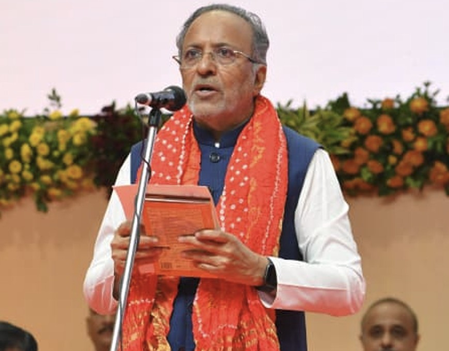
Gandhinagar, Feb 27 (IANS) Gujarat has strengthened its position as a national leader in economic growth, manufacturing, and technological advancement because of strategic investments and decisive fiscal management, Science and Technology Minister Arjun Modhwadia said on Friday.
During the general discussion on the state budget for 2026-27, Modhwadia highlighted that Gujarat’s economic discipline, infrastructure development, and industry-focused policies are attracting talent and investment back to the state.
“Out of the world’s top five to six high-tech industries, four are coming to Gujarat. Tomorrow, under the leadership of Prime Minister Narendra Modi, the inauguration of the Micron semiconductor facility in Sanand will mark a historic event in India’s technological history,” Modhwadia said.
He added that this development is reversing the brain drain, with Indian professionals and CEOs returning from abroad to contribute to Gujarat’s industrial growth.
The minister outlined Gujarat’s proactive response during the COVID-19 pandemic, noting that under Prime Minister Modi, India developed three vaccines in record time and administered them free to 1.4 billion citizens.
“India also extended vaccine assistance to other countries, turning a challenge into an opportunity,” he said.
Under Chief Minister Bhupendra Patel and Deputy Chief Minister Harsh Sanghavi, the state government has implemented measures to support farmers and agricultural production.
Rs 15,000 crore was spent on groundnut procurement, and Rs 11,000 crore was directly deposited into the accounts of farmers across 16,000 villages during monsoon disasters, avoiding delays from survey procedures.
Modhwadia added that modern digital systems now allow farmers to access land records, including 7/12 and 8-A, online without visiting government offices.
Gujarat’s financial management and budgetary discipline were also emphasised.
The state’s budget has reached Rs four lakh crore, with committed expenditure on salaries, pensions, and interest at 47 per cent, significantly lower than states like Punjab, where it is 85 per cent.
Strong GSDP ratios and revenue streams reduce the need for borrowing, allowing investment in large projects such as bullet trains, modern bus stations, airport as well as railway upgrades, and five expressways, including Ahmedabad-Rajkot, Rajkot-Dwarka, and Jetpur-Somnath, which are being built for Rs one lakh crore.
Modhwadia highlighted Gujarat’s leadership in multiple sectors.
The state accounts for 33 per cent of India’s pharmaceutical production and 28 per cent of exports, produces 37 per cent of the country’s cotton, and is home to global manufacturing hubs of Maruti Suzuki and Honda, which produce nearly one million vehicles annually.
In dairy, Gujarat has emerged as the national leader, with the Amul brand achieving global recognition, while Surat’s Diamond Bourse ranks alongside Mumbai in exports and employment generation.
Education and social development remain priorities, with Rs 62,000 crore allocated for education, Rs 7,690 crore for women and child development, and Rs 36,000 crore for urban development.
The state is also leading in renewable energy and advanced technologies, including artificial intelligence.
“India and Gujarat are progressing alongside global leaders in AI, which is a matter of pride for all Gujaratis,” Modhwadia said.
–IANS
mys/dan