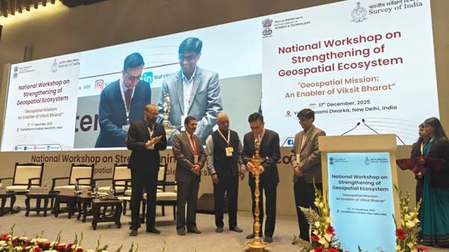
New Delhi, Dec 17 (IANS) Geospatial technologies are a foundational pillar of India’s development journey, and the government is leveraging them as a national asset for Viksit Bharat, said Dr. Jitendra Singh, Union Minister of State (Independent Charge) for Science & Technology on Wednesday.
Addressing the National Workshop on “Strengthening of Geospatial Ecosystem- Geospatial Mission: An Enabler of Viksit Bharat” through a video message, the Minister underscored that India’s geospatial transformation over the last decade reflects a decisive shift from regulation to empowerment in the last decade.
“Geospatial information has emerged as a critical enabler of planning, execution, and service delivery across sectors such as infrastructure, agriculture, defence, urban development, climate action, and disaster management,” Singh said.
He highlighted the landmark geospatial liberalisation reforms of 2021, followed by the National Geospatial Policy, 2022, stating that these measures have democratised access to high-accuracy geospatial data, spurred innovation, strengthened industry participation, and significantly expanded the use of geospatial technologies across domains.
Building on this momentum, the National Geospatial Mission has been launched as a transformative, whole-of-government initiative to create a modern, accurate, and accessible national geospatial infrastructure aligned with the vision of Viksit Bharat 2047.
The Minister emphasised that national priorities such as smart cities, road and rail infrastructure, precision agriculture, logistics optimisation, natural resource management, disaster risk reduction, climate action, and next generation defence preparedness will increasingly depend on reliable, interoperable, and robust geospatial data.
Prof. Abhay Karandikar, Secretary, Department of Science and Technology, said that the Geospatial Guidelines 2021 and the National Geospatial Policy 2022 have created an innovation-driven ecosystem.
“The forthcoming National Geospatial Mission will focus on geodetic modernisation, interoperability, strengthening of geo-ICT infrastructure, integration of emerging technologies such as AI and machine learning, promotion of R&D, and capacity building for a skilled geospatial workforce,” he added.
–IANS
rvt/