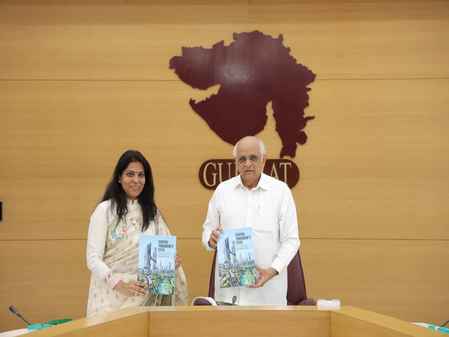
Gandhinagar, March 5 (IANS) Gujarat Chief Minister Bhupendra Patel on Thursday released a book that examines how cities can turn climate risks into opportunities for sustainable growth, amid growing concerns over the pace of urbanisation and its environmental impact.
The book, titled “Shaping Tomorrow’s Cities – From Climate Risk to Green Opportunities”, was launched in Gandhinagar.
It explores pathways for developing sustainable, climate-resilient and innovative cities as urban populations continue to expand worldwide.
The publication has been authored by Shalini Agrawal, Managing Director of Gujarat Urja Vikas Nigam Limited.
It draws on the guidance of Prime Minister Narendra Modi on transforming the challenges posed by rapid urbanisation into opportunities for long-term development.
The book outlines how urbanisation, described as one of the most transformative processes shaping modern societies, can be managed through sustainable planning and climate-resilient infrastructure rather than being treated solely as a challenge.
It reviews global urban development trends and presents a vision for future city planning aligned with climate considerations and innovation.
According to the book, rising urban populations will bring environmental and social pressures that require early planning and policy responses.
It discusses the potential impacts of increased energy demand, higher resource consumption and growing greenhouse gas emissions associated with urban expansion, and proposes approaches to mitigate the effects of climate change.
The publication also notes that urbanisation in India is advancing and is expected to increase significantly by 2047, making cities central to the country’s economic growth.
It highlights that expanding urban populations will place greater pressure on infrastructure, housing, water supply and other basic services, making structured urban planning and sustainable development strategies essential.
In addition, the book outlines financing mechanisms that could support sustainable development projects and climate-resilient infrastructure.
These include the use of green bonds, public-private partnerships, carbon markets and climate finance to mobilise investment for urban development.
It also discusses strengthening the financial capacity of local self-government institutions and improving municipal finance systems so that cities can better raise and manage the funds required for infrastructure and public services.
The publication argues that cities should be viewed not only as centres where challenges arise but also as platforms where social, economic and environmental solutions can be developed through planning, technology and sustainable policy frameworks.
–IANS
mys/pgh