Chhota Udepur/Tapi, July 6 (IANS) Gujarat is set to build its first two air-filled rubber dams using South Korean rubber bladder technology, with the projects expected to improve irrigation, groundwater recharge and flood management in Chhota Udepur and Tapi districts.
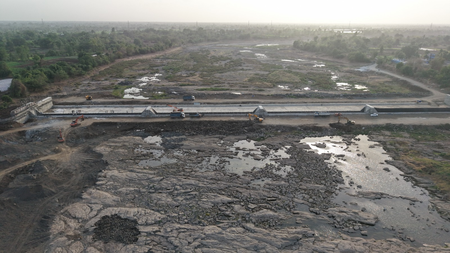
The two dams, currently under construction, include the Rajvasana Rubber Dam on the Heran River in Bodeli taluka of Chhota Udepur district and the Pathakwadi Rubber Dam on the Ambika River in Dolvan taluka of Tapi district. Together, the projects involve an investment of more than Rs 162 crore.
The state government said the projects form part of efforts to strengthen irrigation and water supply infrastructure in remote areas while supporting Prime Minister Narendra Modi’s ‘Catch the Rain’ campaign.
The Rajvasana Rubber Dam is being constructed at an estimated cost of more than Rs 82.97 crore. The project is scheduled for completion by September 2027 within a 30-month construction period.
The dam will feature a 180-metre-long and 3.5-metre-high inflatable rubber bladder installed on the Heran River.
According to the government, the technology will substantially increase the storage capacity of the existing weir, allowing it to store 3.5 million cubic metres (MCM) of water.
Officials said the project will directly benefit farmers in 25 villages by providing irrigation to 3,420 hectares of agricultural land.
The increased water storage is also expected to improve groundwater levels, making irrigation and drinking water more readily available in surrounding areas. Around 75 per cent of the construction work has already been completed.
“The rubber dam system would also address long-standing silt accumulation in the existing weir by allowing complete removal of deposited sand and silt. During periods of heavy rainfall, the inflatable structure can be deflated to allow floodwaters to pass freely, reducing the risk of flooding in nearby villages,” officials said.
As part of the project, a 900-metre flood protection wall will be built along the left bank of the river and a 500-metre wall along the right bank. The construction contract also includes 10 years of operation and maintenance.
The state government said the Rajvasana project would ensure adequate irrigation water for both Kharif and Rabi crops through the existing canal network.
It also plans to connect canals under the Rajvasana weir scheme to village ponds in the 25 beneficiary villages, allowing surplus water to be stored for irrigation and drinking purposes.
The second project, the Pathakwadi Rubber Dam in Tapi district, is being built on the Ambika River at an estimated cost of Rs 79.13 crore.
Based on a Japanese design, the project uses a specialised rubber bladder imported from South Korea and is intended to provide irrigation water to about 650 hectares of farmland.
According to the government, the project will benefit farmers in Pathakwadi, Dhodiyawad, Unai and Sindhai villages by ensuring water availability for both Kharif and summer crops. Construction is about 90 per cent complete.
“The air-filled rubber dam was selected after surveys found that the area’s flat terrain and low riverbanks made conventional high check dams or weir structures unsuitable. The decision followed representations by local farmer leaders and Vyara MLA Mohan Kokani,” officials said.
The Pathakwadi dam has been designed in accordance with Japanese Code 2000 standards. Its rubber bladder, with a thickness ranging from 18 mm to 32 mm, is designed to withstand temperatures above 50°C and has an estimated service life of around 30 years.
The project will be operated through a SCADA-based automation system, enabling the rubber bladder to be inflated and deflated remotely by computer without manual intervention.
The structure will comprise a 2.5-metre-high rubber bladder fixed with J-bolts on a 2-metre concrete base, giving the dam an overall height of 4.5 metres and a total length of 280 metres across four spans.
The government said the design allows the river to flow freely during floods, unlike conventional steel-gated dams, thereby reducing erosion of riverbanks.
Deflating the rubber bladder during high flows will also allow silt to pass downstream, helping preserve the dam’s water storage capacity over time.
The Pathakwadi project is expected to store around 3.5 million cubic metres of water and raise groundwater levels in nearby wells and borewells, improving access to drinking water in surrounding areas.
“The technology could also be used in future as a tidal regulator to help prevent seawater intrusion into freshwater sources,” officials added.
–IANS
mys/rad