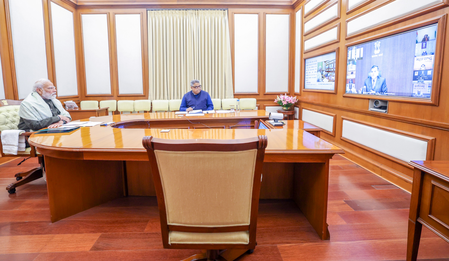
New Delhi, Jan 4 (IANS) Prime Minister Narendra Modi’s personal intervention to resolve issues stalling the progress of big ticket infrastructure projects in the country has played a key role in speeding up economic development in the country.
The PRAGATI initiative (Pro-Active Governance and Timely Implementation) has played a decisive role in ensuring the timely completion of mega projects such as the Pune Metro Rail, the doubling of the Bhubaneswar-Puri rail line, Lumding-Silchar Broad Gauge Railway Line and Rosa – Sitapur Cantonment – Burhwal Rail doubling project stand out as major examples of the decisive impact that has played in ensuring.
The Pune Metro Rail Project Phase-I represents a transformative leap in sustainable urban mobility for the Pune-Pimpri Chinchwad metropolitan region. Implemented under the aegis of the Ministry of Housing and Urban Affairs by Maharashtra Metro Rail Corporation Limited (Maha-Metro), the project spans 33.28 kilometres across two corridors — PCMC–Swargate and Vanaz-Ramwadi — with 30 stations, developed at a total cost of Rs 13,656.22 crore.
During implementation, however, two decisive constraints emerged that could not be addressed through routine administrative processes. A critical stretch of the alignment passed through Defence land under the Khadki Cantonment, where delays in granting working permission and land handover affected construction continuity. In parallel, the alignment near the nationally protected Aga Khan Palace fell within a regulated zone governed under the AMASR (Ancient Monuments and Archaeological Sites and Remains) Act, and the National Monuments Authority declined to issue a No-Objection Certificate, bringing works along this stretch to a halt.
Recognising the national importance of the project, these matters were reviewed at the PRAGATI meeting chaired by Prime Minister on September 26, 2018, when physical progress stood at approximately 24 per cent. Clear, outcome-oriented directions issued at the meeting resulted in the resolution of these bottlenecks which resulted in cutting short the delay in the project and strengthening the execution momentum of the project.
The Doubling of the Bhubaneswar–Delang–Puri Rail Line (70 km) is a critical railway infrastructure project undertaken by the Ministry of Railways and implemented by East Coast Railway in Odisha. This project was conceived in anticipation of the Nabakalebara festival scheduled in July 2015, which was expected to attract nearly 50 lakh devotees as per State Government estimates, the project sought to augment rail capacity on one of India’s most significant pilgrimage corridors. With an anticipated cost of Rs 1,650 crore, the alignment spans Khurda and Puri districts, strengthening connectivity to Puri, a major religious and tourism hub.
Given the fixed festival timeline and anticipated surge in passenger volume, the project faced significant challenges concerning timely completion and commissioning. During the review, the Prime Minister directed that: “as the project is important for the Nabakalebara festival, the Ministry should ensure completion of all works well before the festival.” This directive brought focused accountability to the implementing agency and elevated the project to a “priority status”. Execution efforts were subsequently intensified, departmental coordination was strengthened, and residual works were accorded immediate priority for closure.
Beyond festival requirements, the corridor has contributed to long-term regional connectivity, tourism growth, and economic activity in Odisha.
Similarly, the Rs 8,359 crore Lumding-Silchar Broad Gauge Railway Line is a strategically critical rail infrastructure corridor serving southern Assam (Barak Valley) and providing essential rail connectivity to the hilly States of Tripura, Manipur, and Mizoram.
Despite its importance, the project faced prolonged implementation challenges in its initial years due to constrained fund flow, difficult terrain, adverse weather conditions, limited road connectivity, and insurgency-related disruptions during 2006-2009, which necessitated deployment of the Territorial Army. Normal construction activities could resume only after stabilisation of the security situation post-2009.
The project was reviewed by the Prime Minister under the PRAGATI mechanism, at which time physical progress was minimal. Following the Prime Minister’s guidance, the project received focused attention, including enhanced inter-agency coordination, close monitoring, and time-bound execution, resulting in a significant acceleration in progress.
In the case of the Rs 2,560 crore Rosa – Sitapur Cantonment – Burhwal Rail Doubling Project in Uttar Pradesh, spanning 180 km, was conceived as a key capacity augmentation initiative under the Ministry of Railways was being held up due to lack of forest clearances and slow land acquisition.
Recognising the project’s strategic importance for regional mobility and national logistics, unresolved issues were escalated to the Project Monitoring Group (PMG) portal for structured inter-agency coordination. Subsequently, the matter was taken up for review under the PRAGATI mechanism, chaired by the Prime Minister, ensuring focused attention at the highest level of governance which led to a quick resolution of these issues and speeding up the project.
The project has eliminated single-line constraints on an important section of the Northeastern Railway network, which carries more than 100 passenger and freight trains daily.
–IANS
sps/uk