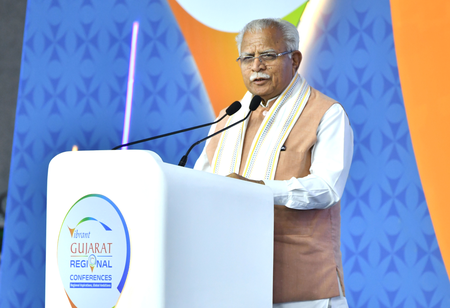
Vadodara, June 29 (IANS) India has maintained both its energy security and economic stability despite recent geopolitical developments in West Asia, Union Minister of Power and Housing and Urban Affairs Manohar Lal Khattar said on Monday, attributing the country’s resilience to long-term planning, power sector reforms and investments in urban infrastructure.
Addressing the inaugural session of the Vibrant Gujarat Regional Conference (VGRC) for Central Gujarat in Vadodara, the minister said a reliable energy system, modern cities and responsive governance together form the foundation of sustainable industrial growth and investor confidence.
Referring to recent international developments, Manohar Lal said India’s preparedness had helped the country withstand global uncertainty.
“Despite recent global geopolitical developments, particularly the events in West Asia, we have maintained and strengthened our energy security. Our economic stability has also remained intact. While many countries experienced uncertainty and fluctuations, India has maintained stability with confidence,” he said.
The minister said reforms in the electricity distribution sector had strengthened the financial health of distribution companies while improving consumer services.
“We have implemented significant distribution reforms. As a result, distribution companies, which had long been running at losses, have seen improvements in their financial position. Consumers are receiving better services, and the sector has become more financially sustainable, creating greater opportunities for future investment,” he said.
Manohar Lal said strong infrastructure extends well beyond industrial estates and factories, with investors increasingly evaluating the quality of urban services before deciding where to establish businesses.
“When an investor chooses a state, they do not look only at incentive schemes. They also consider whether adequate housing is available for the workforce, how efficient mobility and public transport systems are, the quality of water supply and sewerage systems, the effectiveness of digital governance, standards of cleanliness and the overall ease of living,” he said.
He said the Centre had therefore integrated urban development with economic development, describing cities as engines of growth, innovation and employment rather than merely centres of population.
Highlighting flagship schemes, the minister said the Pradhan Mantri Awas Yojana (Urban) and PMAY 2.0 had together been approved for the construction of 1.27 crore houses nationwide, of which 98.65 lakh had already been completed and handed over to beneficiaries.
“In Gujarat, approval has been granted for more than 11.5 lakh houses, out of which more than 10 lakh have already been handed over,” he said.
He added, “Under the AMRUT programme and related initiatives, Gujarat has received 28 lakh new water supply connections and 42.47 lakh sewerage connections.”
The minister also highlighted India’s expanding urban transport network, noting that Metro rail services are now operational in 29 cities.
“Today, India has a Metro rail network spanning 1,155 kilometres, making it the third-largest Metro rail network in the world after China and the United States,” he said, adding that the 82-kilometre Delhi-Meerut Regional Rapid Transit System represented another major milestone in high-speed urban mobility.
On financial inclusion, Manohar Lal said more than 76 lakh street vendors had received institutional loans under the PM SVANidhi scheme to support their businesses.
“It is a matter of great satisfaction that more than 40 lakh beneficiaries have repaid their loans in full while successfully expanding their businesses. Nearly eight lakh have progressed through all three loan tranches and moved on to avail themselves of larger loans under schemes such as PM Mudra,” he said.
The minister said improved housing, transport and urban services directly enhance industrial productivity by improving workers’ quality of life.
“When workers have homes, transportation facilities and quality urban services, productivity increases. This, in turn, also enhances the productivity of our industries,” he said.
Manohar Lal cited Gujarat’s urban achievements, noting that Ahmedabad had been recognised as India’s cleanest large city, while Surat secured a place in the Super Swachhata League.
“These achievements reflect Gujarat’s commitment to cleanliness, scientific waste management, public participation and efficient urban governance,” he said.
Calling Gujarat a model for India’s development journey, the minister said the state’s industrial policy, emphasis on advanced manufacturing, MSMEs, green growth, innovation and women-led development would further strengthen its position as a preferred investment destination.
Further, Minister Manohar Lal invited domestic and international investors to invest in Gujarat, saying the relationship between governments and investors should go beyond official partnerships.
“In some countries, we speak of G2G, B2B, G2B and B2G relationships. In India, we also believe in H2H… Heart to Heart. We will always lay a red carpet before every investor who comes to Gujarat or any state in the country,” he said.
–IANS
mys/uk