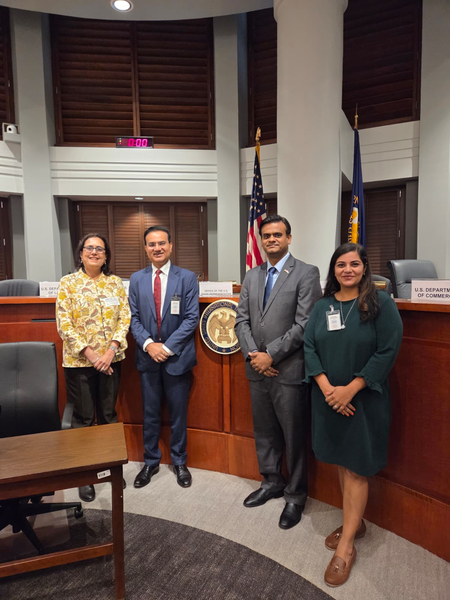
Washington, July 8 (IANS) India argued on Wednesday that the U.S. Trade Representative’s proposed Section 301 tariff framework contradicts its own objective of eliminating forced labour by exempting certain products while seeking broad import restrictions on countries including India, urging Washington to pursue bilateral dialogue instead of sweeping trade measures.
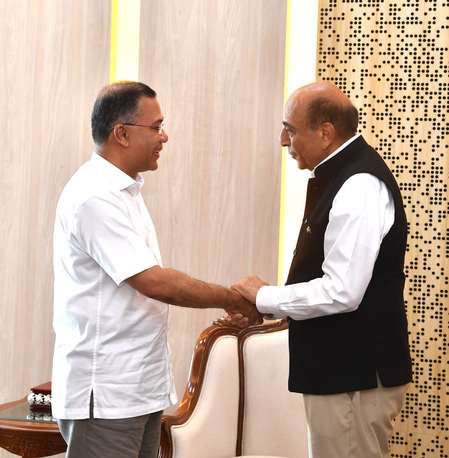
The argument was made by Dr. Brij Mohan of the Ministry of Commerce and Industry during a public hearing after a USTR official questioned India’s written submission, which contended that exemptions proposed under the tariff plan undermined Washington’s stated policy objective.
The USTR official asked whether India was suggesting that, in the absence of tariffs, goods produced with forced labour would continue entering international supply chains. The official also sought clarification on whether any tariff exemptions could be justified if import restrictions were considered necessary to keep such goods out of global commerce.
Responding, Dr. Mohan said India’s objection was not to exemptions themselves but to what it viewed as inconsistencies in the USTR’s methodology.
He pointed out that the USTR itself had proposed exemptions for products that cannot be grown or produced in sufficient quantities in the United States or obtained from alternative sources.
“What we submitted… is inconsistent with the overall approach,” he said, arguing that such exemptions weakened the rationale for imposing economy-wide tariffs.
He also referred to provisions in the Federal Register notice that would allow reduced tariff treatment for certain textile and apparel imports based on the use of U.S.-origin textile inputs.
According to Dr. Mohan, this mechanism permits trading partners using American textile materials as raw inputs to export corresponding volumes of finished products to the United States at lower tariff rates.
He argued that such provisions influence sourcing decisions on commercial grounds while failing to fully address concerns over forced labour.
Dr. Mohan further highlighted exemptions for agricultural commodities including coffee, vanilla, cinnamon, cloves and several fruits.
He noted that some of these products also appear on the U.S. Department of Labour’s own list of goods associated with child labour or forced labour risks.
“This creates a contradiction and inconsistency in the US’s own approach,” he said, arguing that commercial considerations behind the exemptions weaken the USTR’s case that economy-wide import restrictions are necessary to eliminate forced labour from international supply chains.
The exchange stemmed from India’s detailed written submission to the USTR, in which the Ministry of Commerce argued that the proposed exemptions “do not reconcile with and undermine” the USTR’s stated policy that eliminating forced labour is both “an economic and moral imperative” and that import prohibitions are a key means of achieving that objective.
In his testimony, the Indian official specifically questioned the proposal to grant lower tariff rates on specified volumes of textile and apparel imports, contingent on purchases of U.S.-made textile inputs.
Dr Mohan argued that the mechanism effectively rewards sourcing decisions rather than addressing whether products are actually connected to forced labour. This creates an arbitrary incentive for manufacturers to use American raw materials while allowing corresponding exports to qualify for preferential treatment, he said.
Among other things, he argued that exempting agricultural commodities such as coffee, vanilla, cinnamon, cloves and several fruits sits uneasily alongside the U.S. Department of Labour’s own findings identifying some agricultural products, including coffee and cocoa, as being associated with forced labour risks. It said these commercial exemptions weaken the policy rationale behind imposing country-wide tariffs on trading partners.
Dr. Mohan reiterated India’s willingness to engage with Washington to address any specific concerns.
“We remain open to dialogue and cooperating to resolve any specific concerns that may arise from India’s imports and exports involving any such issues,” he said.
He added that such issues should be addressed “in the framework of Indian US… Trade negotiation, and not in this investigation”
–IANS
lkj/dan